On September 23, 2026, Zongzhao Zhai (Hunan Normal University) and Yirong Wang and Jiongming Lu (Hunan University)—serving as co-corresponding authors—along with co-first authors Jun Wang (Hunan Normal University) and Zixin Cai (Hunan University), published a research paper titled "Lsp2 links mTORC1 to TOP mRNA translation and lifespan in Drosophila" in the prestigious international journal Nature. The study demonstrated for the first time at the organismal level that 4E-BP selectively regulates TOP mRNA translation and influences lifespan. It identified a rapamycin-insensitive mTORC1 branch as a target for longevity intervention and revealed Lsp2 as an mTORC1-regulated circulating protein associated with aging, thereby offering new insights for the selective inhibition of mTORC1 function and the development of anti-aging intervention strategies.

Service Support
Mabnus Biotech was responsible for the expression of recombinant Lsp2 protein and the custom antibody development services in this study.

Background:
The Unsolved Mysteries of mTORC1, TOP mRNA, and Aging
mTORC1 is a core pathway for cells to sense nutrients and coordinate metabolism and aging. It promotes protein synthesis by phosphorylating 4E-BP and S6K, and inhibiting mTORC1 can prolong the lifespan of various organisms. However, long-term use of rapamycin to inhibit mTORC1 can lead to metabolic and immune side effects because it also inhibits mTORC2. Therefore, selectively inhibiting specific downstream functions of mTORC1 has become an important direction in anti-aging research.
TOP mRNA (5' terminal oligopyrimidine motif mRNA) primarily encodes ribosomal proteins (RPs), accounting for 15–20% of total cellular transcripts, making it the most translationally burdensome class of mRNAs. mTORC1 preferentially regulates TOP mRNA translation via 4E-BP, but this function is insensitive to rapamycin. However, how TOP mRNA translation is regulated at the physiological level and how it affects lifespan remains unclear.
Key findings
Lsp2 is an EAA-induced adipokine that negatively regulates lifespan.

Fig. 1
Lsp2 is induced by essential amino acids (EAA) via mTORC1.
Transcriptome analysis revealed that Lsp2 (encoding larval serum protein) was significantly upregulated during both protein diet and aging (Fig. 1a–c). Lsp2 expression was primarily located in the head fat body and was rapidly and reversibly induced by protein diet (Fig. 1e–f). Further experiments showed that:
• A mixture of 10 EAAs strongly induced Lsp2, while non-essential amino acids (NEAAs) could not (Fig. 1g).
• Removing most individual EAAs significantly reduces Lsp2 induction, indicating that Lsp2 is an indicator of EAA integrity (Fig. 1h).
• The mTORC1 signaling pathway (RagA/B, mTOR, Rheb, TSC1) positively regulates Lsp2, and inhibiting mTORC1 can completely block EAA-induced Lsp2 expression (Fig. 1i–j).

Fig. 2
Lsp2 deficiency significantly prolongs lifespan without impairing reproductive fitness.
Researchers constructed Lsp2 mutants and found that under various SYA diets (0–20% yeast), the lifespan of Lsp2 mutants was significantly extended, with a median lifespan increase of up to 42% (males) and 28% (females) (Fig. 2a–b). Overexpression of Lsp2 shortened lifespan (Fig. 2c–d). The extended lifespan was not accompanied by a decrease in reproduction, exercise, or stress resistance. In fact, mutants aged 8–10 days had a higher egg production.
Mechanism Analysis
Lsp2 selectively promotes TOP mRNA translation via 4E-BP.

Fig. 3
Lsp2 promotes global translation but selectively modulates RP translation.
Lsp2 deletion increases eIF2α phosphorylation, reduces global protein synthesis (Fig. 3a–b), and leads to a decrease in the 40S subunit and an increase in the 60S subunit, suggesting impaired ribosome assembly (Extended Data Fig. 6e). Polysome-seq and translation efficiency (TE) analysis showed that Lsp2 deletion significantly reduced the TE of 66 mRNAs, of which 48 were cytoplasmic ribosomal protein (RP) mRNAs (Fig. 3e–f).
4E-BP is a key mediator of Lsp2 regulation of RP translation and lifetime.
Knocking out 4E-BP (Thor) in the Lsp2 mutant completely rescued the RP translation defect (Fig. 3g–h). At the same time, after knocking out Thor, the life extension caused by Lsp2 deletion almost disappeared (Fig. 3i). Lsp2 promotes 4E-BP phosphorylation, and this process depends on mTORC1 and GATOR2 (Fig. 4a–d).

Fig. 4
The difference between Lsp2 and the effect of rapamycin
Rapamycin inhibits S6K but not 4E-BP phosphorylation (Fig. 4e–f), while Lsp2 deletion reduces both S6K and 4E-BP phosphorylation. Lsp2 mutants are more sensitive to rapamycin, with low doses prolonging lifespan and high doses being harmful (Fig. 4g).
Evolutionary perspective
TOP motif and 4E-BP co-occur in Drosophila

Researchers systematically identified Drosophila TOPmRNAs and predicted a total of 136 TOP genes, of which 82 were RP genes (Fig. 5a). The TOP motif is highly conserved in Drosophila RP mRNA and appears in conjunction with 4E-BP, while it is absent in yeast, nematodes, and plants (Fig. 5b). Mutating the TOP motif can reduce RP protein levels without affecting transcription (Fig. 5c). Lsp2 deletion or overexpression can selectively regulate TOP mRNA translation (Fig. 5d).
In conclusion
Core model: EAA → mTORC1 → Lsp2 (adipokine) → feedback activation of mTORC1 → 4E-BP phosphorylation → TOP mRNA translation → shortened lifespan.
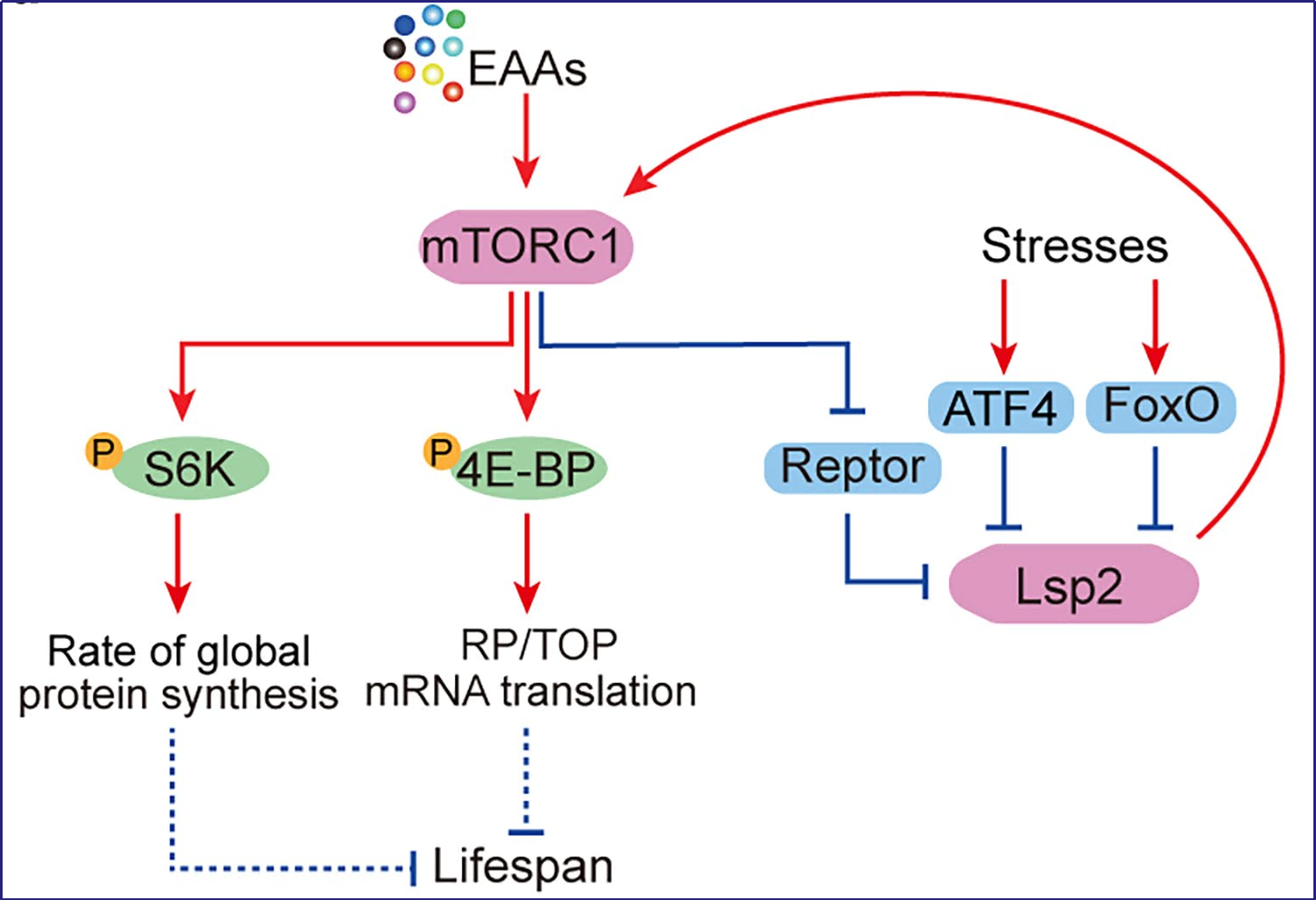
Lsp2, as a nutrient-induced mTORC1 feedback activator, integrates signals such as EAA, insulin, FoxO, ATF4, and ecdysone in the fat body, amplifies mTORC1 output, and selectively promotes RP translation, thereby accelerating aging.