Canine parvovirus (also known as CPV or parvovirus) is a contagious virus that primarily infects dogs, but can also infect other mammals, including foxes, wolves, cats, and skunks. There are two types of canine parvovirus, called canine parvovirus type 1 (CPV1) and CPV2. CPV2 causes the most severe illness, and there are variants of CPV2 such as CPV-2a and CPV-2b. CPV2 is an enveloped single-stranded DNA virus belonging to the Parvoviridae family. This virus is very similar to feline panleukopenia (also a parvovirus), sharing 98% amino acid identity, differing only in two amino acids of the viral capsid protein VP2. CPV2 is highly contagious and spreads between dogs through direct or indirect contact with feces or virus-contaminated objects. VP2 induces the production of specific neutralizing antibodies, making it a key target for protective immunity and a core antigen in vaccine development (such as virus-like particle (VLP) vaccines).
Structure of CPV and capsid protein VP2
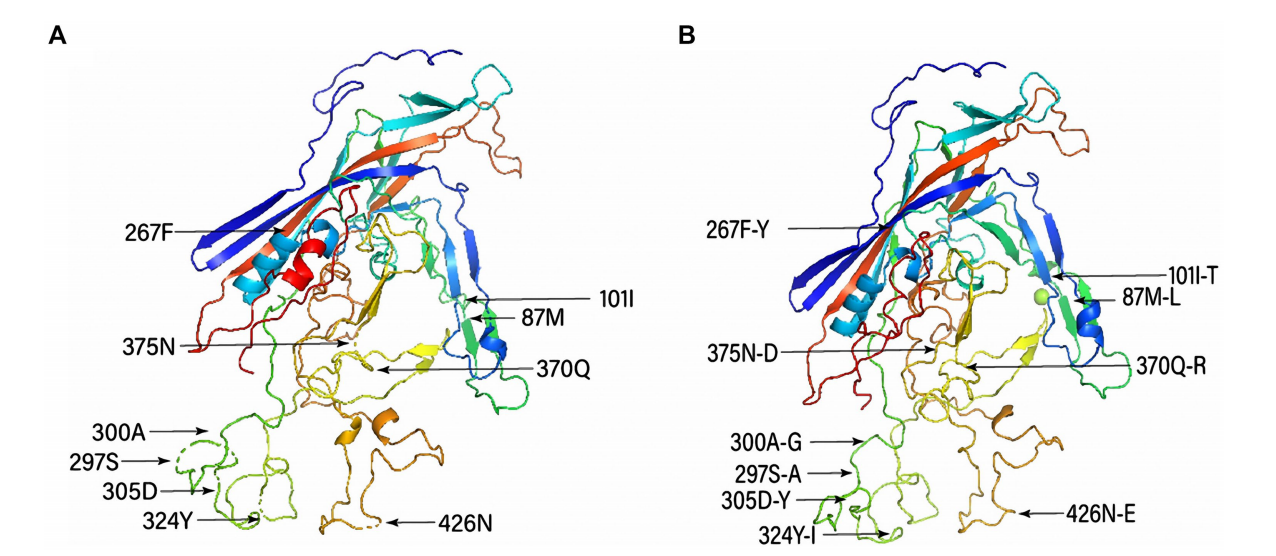
CPV is a small, non-enveloped virus characterized by an icosahedral capsid (T=1 symmetry) approximately 26 nanometers in diameter. The viral genome consists of a 5 kb linear single-stranded negative-sense DNA. The virus encodes two non-structural proteins (NS1 and NS2) and two structural proteins (VP1 and VP2) within two open reading frames. VP1 and VP2 are the major structural proteins, forming the viral capsid through alternative splicing of mRNA. VP2 accounts for approximately 90% of the capsid mass. These structural proteins consist of eight antiparallel β-barrel domains linked by loop structures to form the capsid surface. The viral particle exhibits spike-like projections around the triaxial axis, concave folds at the biaxial axis, and cylindrical channels along the pentaxial axis. Basic region 1 (BR1) of the VP1 capsid protein functions as a nuclear localization signal (NLS), while the 300th amino acid of VP2 determines host specificity. Amino acid mutations in the VP2 protein can also occur at positions 5, 267, 324, 370, 440, and 481. Specifically, Ala5Gly, Thr440Ala, and Arg481Lys may alter the viral antigenic structure and immunogenicity. Y324I and Gln370Arg may affect the host range of viral infection by influencing receptor binding.

(Data source: López-Astacio RA, et al. J Virol. 2023)
(Data source: Pan S, et al. Front Vet Sci. 2023)
Pathogenesis of CPV
CPV infection activates caspase-8 and caspase-12, leading to the accumulation of reactive oxygen species (ROS). This accumulation reduces mitochondrial membrane potential, triggering the release of cytochrome c and activating caspase-9. Ultimately, caspase-8 and caspase-9 synergistically upregulate caspase-3 expression, inducing apoptosis. CPV can bind to TfR receptors, promoting its entry into lysosomes via endocytosis. Furthermore, this interaction activates the EGFR (Y1086)/p27 and STAT3 (Y705)/cyclin D1 signaling pathways, resulting in cell cycle arrest. Once inside the host cell, CPV causes DNA damage, triggering cell cycle arrest and apoptosis. This process increases nuclear membrane permeability, allowing the viral capsid to escape via a CRM1-independent nuclear export pathway. The CCT7 subunit of the chaperone protein TRiC/CCT can interact with the VP2 protein, enhancing its stability and thus promoting CPV replication.

(Data source: Zhou H, et al. Microorganisms. 2024)
Targeted therapy for CPV
Currently, the main treatment for canine parvovirus is antiviral therapy. Research on antiviral drugs mainly focuses on four categories: interferon-based preparations, antibody-based therapies, chemical drugs, and other types of treatments.

(Data source: Zhou H, et al. Microorganisms. 2024)
Anivovetmab (KIND-030) is a canine parvovirus monoclonal antibody approved by the U.S. Department of Agriculture (USDA) for the treatment and prevention of canine parvovirus infection in puppies 8 weeks of age and older. The canine parvovirus monoclonal antibody provides passive immunity by binding to circulating canine parvovirus. When administered alone on day 4 after experimental infection in puppies (without supportive care), it reduces mortality.
A study conducted by Oluwafemi F. Adu and Susan L. Parrish, in collaboration with a team from Cornell University's College of Veterinary Medicine and other institutions, analyzed three canine monoclonal antibodies (cMAbs): 2C5, 3G6, and 7C8. They found that cMAb 7C8, similar to KIND-030, can bind to and neutralize CPV virus. Given the high in vitro activity of cMAb 7C8, its binding and neutralization efficiencies were compared with those of KIND-030. cMAb 7C8's binding ability to the CPV capsid (~EC50, 0.005) was stronger than that of KIND-030 (~EC50, 0.021), but their neutralizing activities were similar, both exhibiting an IC50 value of approximately 0.01 nM.

(Data source: Adu OF, et al. Proc Natl Acad Sci USA. 2025)