Cats are a leading source of indoor inhaled allergens after dust mites. The global incidence of cat allergy is rising rapidly, posing a significant public health problem. Several cat allergens have been identified. Fel d1, a small dimeric urea protein produced by the sebaceous, salivary, lacrimal, and anal glands of cats, is diffused into the skin and fur during grooming and is a major allergen causing sensitization in humans. Fel d1 levels are influenced by various factors, including the cat's species, sex, neutering status, and anatomical location. Studies have shown that male cats produce more Fel d1 than female cats. Furthermore, neutered male cats produce less Fel d1 than undressed male cats. Cat allergy can cause a variety of symptoms, including allergic rhinitis, conjunctivitis, and asthma.

(Data source: Jiang Y, et al. Int J Mol Sci. 2025)

(Data source: Demoly P, et al. Clin Transl Allergy. 2026)
Fel d 1 structure
Fel d 1 belongs to the secretory globulin family and is a glycoprotein with a molecular weight of approximately 35-38 kDa. It consists of two identical heterodimers, each 18-19 kDa, linked non-covalently to form a tetramer. Each dimer consists of two polypeptide chains (chain 1 and chain 2) covalently linked by three disulfide bonds and encoded by two different genes. Chain 1 (or the α-chain) consists of 70 amino acids and has a molecular weight of 8 kDa. This polypeptide is structurally highly similar to rabbit lipophilin/secretory globulin (Ory c 3) and sequence-homologically similar to another member of the uterine globulin family, the Clara cell 10-kDa protein found in human bronchial epithelial cells. Chain 2 (or the β-chain) is a 10 kDa glycoprotein containing N-oligosaccharides and consists of 85, 90, or 92 amino acids. In its native state, Fel d 1 is considered a mixture of the full and truncated forms of chain 2. The three-dimensional structure of Fel d1 has been determined. Its structure is more complex than that of other allergens, with an internal space that can accommodate endogenous ligands and two calcium ion binding sites.

(Data source: Bonnet B, et al. Allergy Asthma Clin Immunol. 2018)
Targeted therapy for Fel d1
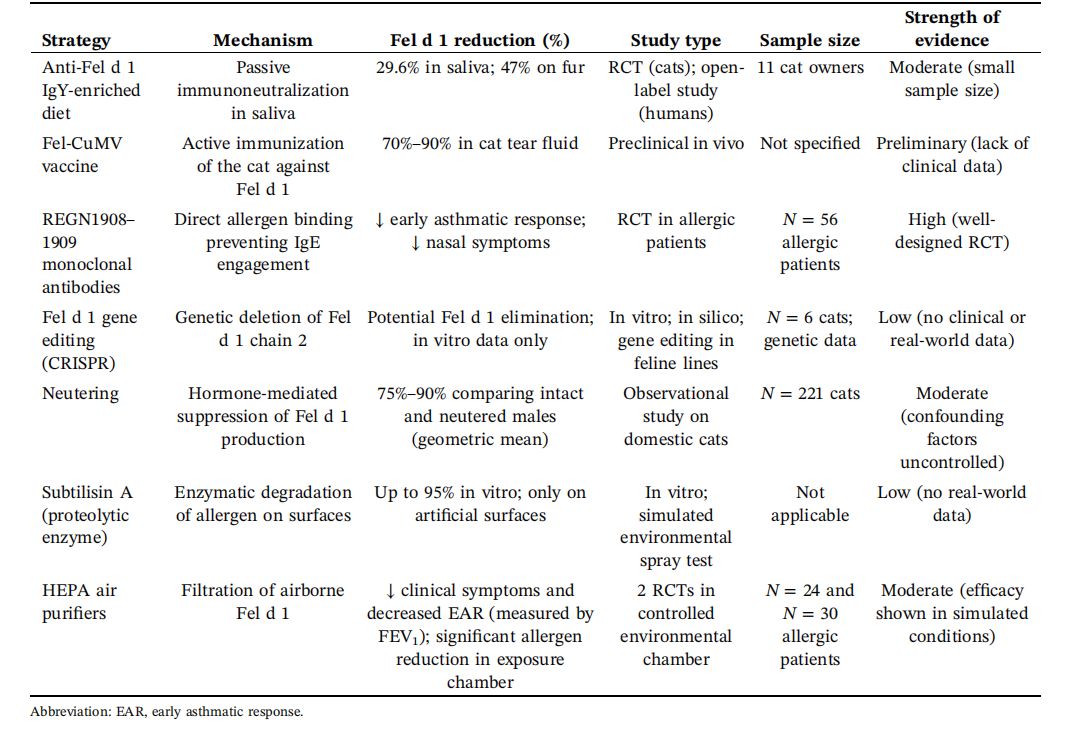
Immunotherapy options include the Fel-CuMV vaccine for cats and monoclonal antibody therapy for humans (REGN1908-1909), both of which significantly reduce allergy symptoms. Among innovative approaches, the Fel-CuMV vaccine (HypoCat) stands out due to its ability to induce neutralizing antibodies in cats themselves. In one study, cats vaccinated with the Fel-CuMV vaccine showed a significant increase in IgG antibody levels against Fel d1 (p < 0.001), thereby reducing levels of active allergens.
(Data source: Colosimo S, et al. Clin Transl Allergy. 2025)
REGN1908 (freneslerbart) and REGN1909 (mevonlerbart) are fully human IgG4 monoclonal antibodies targeting two distinct, non-overlapping epitopes on Fel d1, developed using Regeneron's VelocImmune human antibody mouse platform. Both molecules bind to these epitopes non-competitively. A randomized, double-blind, placebo-controlled phase 1b mechanism validation study demonstrated that intravenous administration of neutralizing IgG antibodies (targeting Fel d1) suppressed allergic nasal symptoms induced by cat dander extracts in patients with feline allergy. In patients with feline allergy, a single subcutaneous administration of the combined monoclonal antibodies (REGN1908-1909; 600 mg, 1:1 ratio) rapidly reduced overall nasal symptoms by blocking the early anaphylactic response of the feline allergen challenge (NAC) and significantly reduced the mean wheal size in the feline allergen skin prick test within one week of initial administration.
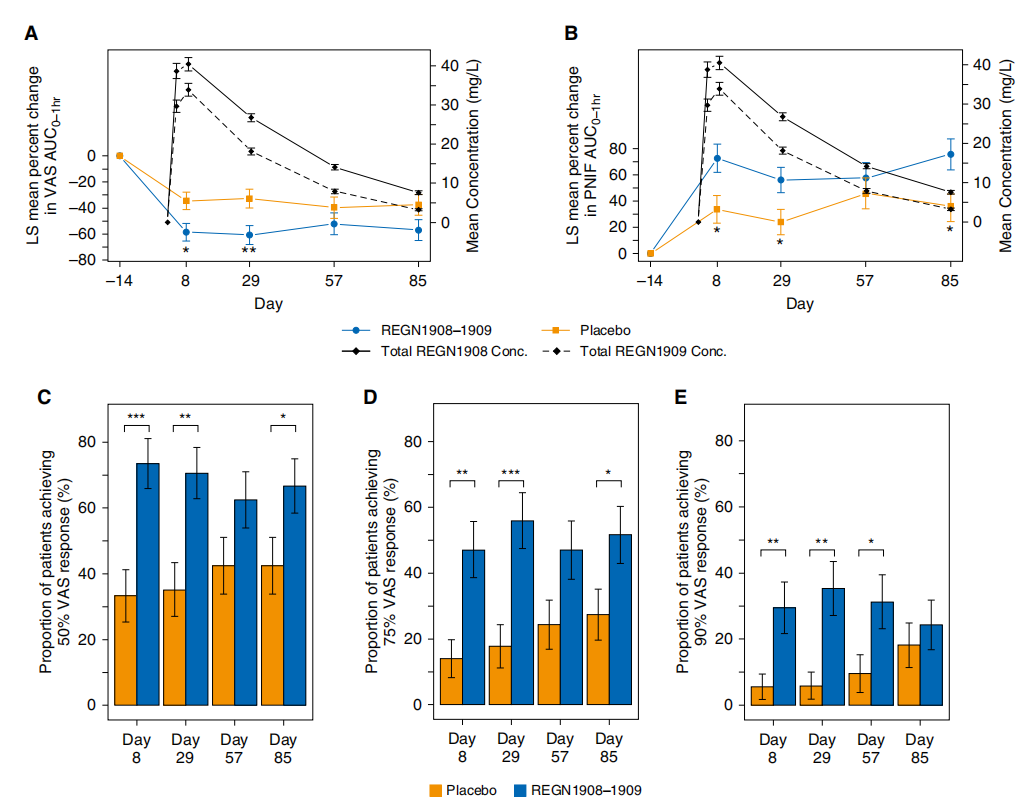
(Data source: Shamji MH, et al. Am J Respir Crit Care Med. 2021)
The use of REGN1908/909 has been shown to prevent early asthma reactions (EAR) in patients with mild asthma and feline allergy. At days 8, 29, 57, and 85 post-treatment, patients receiving treatment showed improved respiratory function compared to the placebo group. Specifically, on day 8, the mean improvement rate of FEV1 was 15.15% in the treatment group, compared to 1.59% in the placebo group (difference: 13.56%, p < 0.001), and on day 85, it was 12.73% in the treatment group and 0.20% in the placebo group (difference: 12.54%, p = 0.008). Furthermore, the incidence of EAR was reduced; during the exposure period on day 85, 50% of treated patients did not experience an acute exacerbation, compared to approximately 80% in the placebo group.
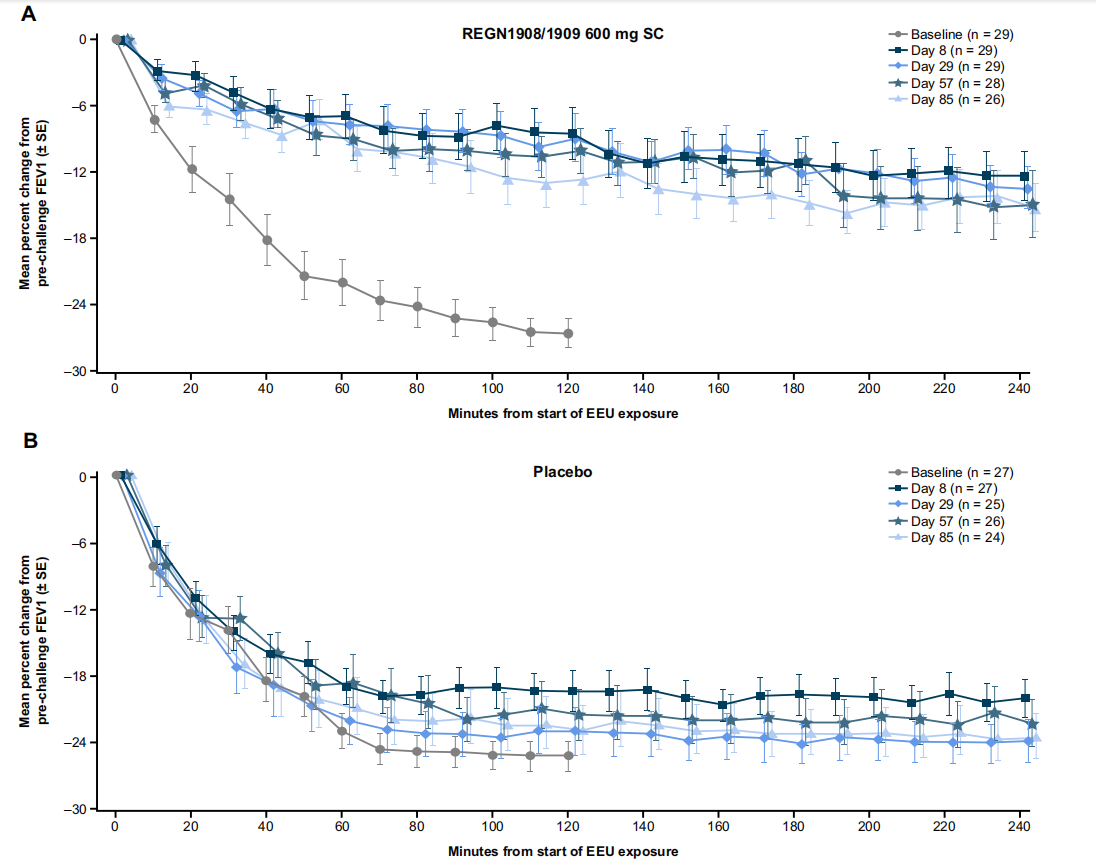
(Data source: de Blay FJ, et al. J Allergy Clin Immunol. 2022)