Pseudomonas aeruginosa (P.aeruginosa) is a ubiquitous Gram-negative opportunistic pathogen that causes a variety of serious infections, including those associated with cystic fibrosis, hospital-acquired pneumonia, burn wound infections, and sepsis. The pathogenicity of P.aeruginosa is attributed to multiple virulence mechanisms, among which the type III secretion system (T3SS) plays a crucial role in evading the immune system and adapting to the host. The T3SS acts like a syringe, allowing effector proteins to be translocated into host cells, which disrupts cell signaling, suppresses the immune response, and promotes bacterial spread. Effector proteins such as ExoS and ExoU, as well as components of the needle-like complex, are potential therapeutic targets for treating P.aeruginosa infections.
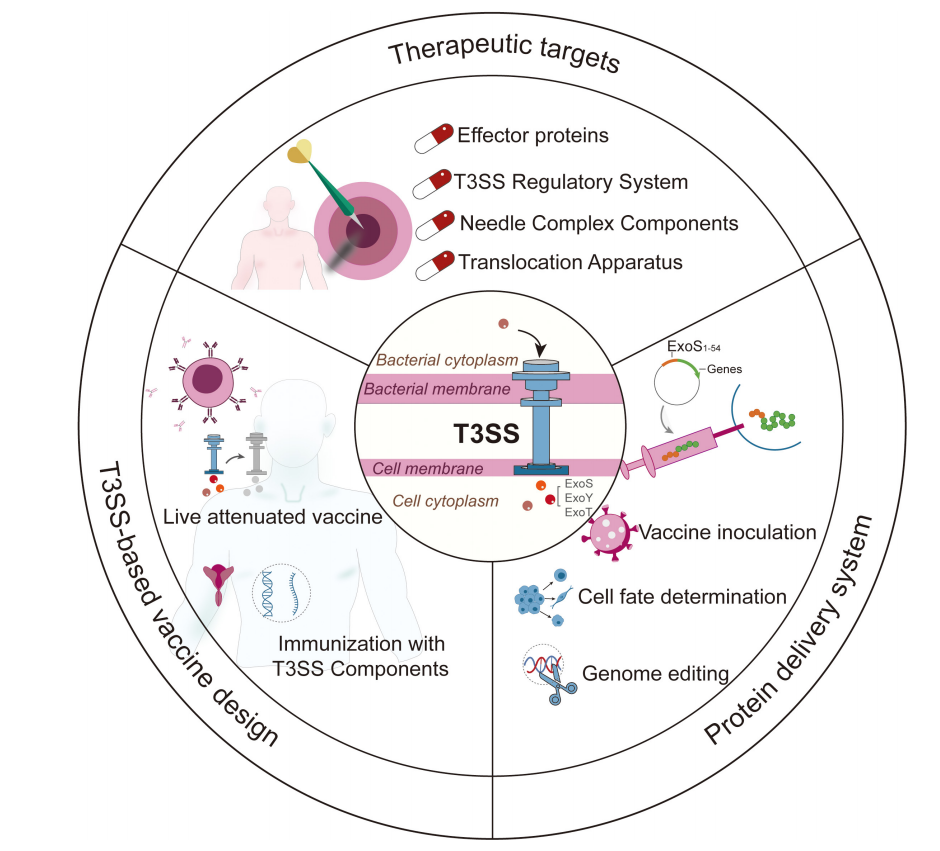
(Data source: Su T, et al. Front Microbiol. 2025)
T3SS Structure
The type III secretion system (T3SS) is a multi-subunit protein complex used by Gram-negative pathogens to initiate and maintain infection. Structurally, the T3SS of P.aeruginosa resembles a molecular syringe, comprising five main parts: the needle complex, translocation apparatus, regulatory system, effector proteins, and chaperone proteins. The needle complex can be further subdivided into extracellular appendages, membrane components, and cytoplasmic components. The basal body traverses the inner and outer membranes; the inner membrane loop is composed of PscJ and PscD, while the outer membrane loop is formed by PscC. The exit apparatus is located on the basal body and is assembled from PscR, PscS, PscT, PscU, and PcrD. Among these, PscR, PscS, and PscT act as inner membrane proteins, while PscU regulates the secretion switch. PcrD assembles into a ring structure that links the ATPase complex to the secretory pore. The cytoplasmic component includes a C-ring composed of PscQ and an ATPase complex comprising PscN, PscL, PscO, and PscK. PscN assembles into a hexamer structure via the bridging protein PscO, interacting with PcrD. The inner rod connects to the inner membrane ring via a "socket" structure, supporting needle-like projections extending from the bacterial surface; their length is regulated by PscP. The transposition apparatus consists of two hydrophobic proteins (PopB, PopD) and one hydrophilic protein (PcrV) secreted by the T3SS itself. PopB and PopD interact with the host cell membrane to form transposition pores, transporting effectors from the needles across the host cell membrane and into the host cytoplasm. PcrV is essential for the functional assembly of the PopB/D transposition complex. The entire T3SS structure, also known as the "injector body," is structurally homologous to the flagellar hook-matrix complex and works synergistically to ensure efficient effector secretion and precise host cell invasion.

(Data source, Deng W, et al. Nat Rev Microbiol. 2017)
T3SS-mediated interactions in host cells
The type III secretion system (T3SS) injects a variety of proteins into the host cell cytoplasm, including exotoxins S, T, Y, or U, and flagellin FliC (flagellate monomers). These proteins induce cytotoxicity, disrupt the actin cytoskeleton, and activate the NLRC4 inflammasome, leading to caspase-1 activation. The activated enzyme cleaves precursor IL-1β into mature IL-1β and precursor IL-18 into IL-18, both of which are subsequently released from the cell, inhibiting the IL-17 signaling pathway. Lipopolysaccharide (LPS) or flagella (fT3SS) can activate the NF-κB pathway via the TLR4 or TLR5 signaling pathways, inducing the production of inflammatory cytokines. This system is a target for a variety of molecules that can act on T3SS components, effector proteins, or gene regulation, as well as on the host cell response.

(Data source: Anantharajah A, et al. Trends Pharmacol Sci. 2016)
Targeted therapy for T3SS
Gremubamab is a novel bispecific IgG1κ monoclonal antibody designed to simultaneously target two key virulence factors in Pseudomonas aeruginosa: PcrV protein (a key component of the type III secretion system (T3SS)) and Psl (an exopolysaccharide involved in biofilm formation and immune evasion). By inhibiting T3SS-mediated toxin release and biofilm-associated protective mechanisms, Gremubamab aims to neutralize bacterial virulence and enhance host immune function. Results from the GREAT-2 trial, a multicenter, randomized, double-blind, placebo-controlled study, met its primary endpoint: gremubamab significantly reduced bacterial load in patients with bronchiectasis and chronic Pseudomonas aeruginosa infection compared to placebo. Gremubamab was well tolerated in the study, with similar incidence of adverse events and serious adverse events in both the gremubamab and placebo groups.

(Data source: EMBARC official website)
Rivabazumab (KB001) is a recombinant, PEG-modified human Fab' fragment that targets the PcrV protein of Pseudomonas aeruginosa(PA), a key component of the type III secretion system (T3SS), which is involved in PA pathogenicity. T3SS injects exotoxins into eukaryotic cells, leading to cytotoxicity in macrophages and neutrophils. Due to the lack of its Fc effector domain, Rivabazumab acts as an inhibitor of T3SS. A randomized, double-blind, placebo-controlled phase IIA clinical trial evaluated the efficacy of Rivabazumab in mechanically ventilated patients with PA. Results showed that within 28 days after infusion, the incidence of PA pneumonia was lower in the Rivabazumab group (33% in the 3 mg/kg group and 31% in the 10 mg/kg group) than in the placebo group (60%), representing a relative risk reduction of approximately 47%.