C-reactive protein (CRP), a biomarker of inflammation, is an acute-phase protein primarily synthesized in the liver in response to various inflammatory stimuli. CRP is composed of five identical subunits that form a planar ring, making the protein highly stable. CRP levels increase in response to infection and tissue damage, as well as in various active disease states. Elevated CRP levels are considered a useful marker for identifying patients at risk for cardiovascular disease and certain cancers. CRP has received widespread attention as a nonspecific marker for assessing and monitoring the development of infection and inflammation, and as a prognostic marker for cardiovascular events. CRP plays an important role in cardiovascular disease, inflammatory diseases, and cancer.
CRP structure:
Native CRP is a pentameric structure (pCRP) composed of five identical globular subunits tightly assembled through non-covalent bonds into a disc-shaped pentameric structure with a central cavity. Each CRP subunit contains a hydrophobic core composed of two antiparallel β-pleated sheets, stabilized by intrachain disulfide bonds. CRP can bind to a variety of ligands, such as phosphocholine (PC), and this binding is dependent on calcium ions. The co-crystal structure of CRP and PC reveals that the primary interaction is between the phosphate group of PC and the CRP-bound calcium ion. Under specific conditions, pCRP will dissociate into the monomeric form mCRP.

(Data source: Yao Z, et al. Inflamm Res. 2019)
Effects of CRP conformational changes on inflammation:
Pentameric CRP (pCRP) acts as an opsonin, enhancing bacterial phagocytosis by monocytes and neutrophils. pCRP binds to exposed phosphocholine (PC) or phosphoethanolamine (PE) head groups on the surface of activated or damaged cells, or to microvesicles containing PC head groups, leading to a conformational change that produces a partially dissociated pentamer (pCRP*), which then dissociates into its monomeric subunits (mCRP). Production of pCRP*/mCRP leads to the expression of proinflammatory effects, including stimulation of monocyte adhesion to endothelial cells, enhanced platelet-monocyte aggregate formation, production of the proinflammatory cytokines TNF-α, IL-1β, and IL-6, and triggering the extrusion of neutrophil extracellular traps (NETs). These factors contribute to hindlimb allograft rejection and renal ischemia-reperfusion injury in rats. The monovalent CRP inhibitor C10M prevents pCRP binding to PC/PE and the conformational change of pCRP to pCRP*/mCRP, thereby reducing proinflammatory effects. This prevents graft rejection and ischemia-reperfusion injury without affecting pCRP-mediated phagocytosis.

(Data source: Filep JG. EMBO Mol Med. 2023)
Relationship between CRP and disease
Elevated CRP levels in the inflammatory and tumor microenvironment promote the development of various cancers, including breast, liver, kidney, and pancreatic cancers, by interacting with various inflammatory molecules. CRP also induces angiogenesis and increases the secretion of inflammatory factors in the tumor microenvironment. Furthermore, serum CRP levels are correlated with tumor size, clinicopathological features, and lymph node metastasis. CRP is considered an important biomarker for tumor prognosis and treatment response.
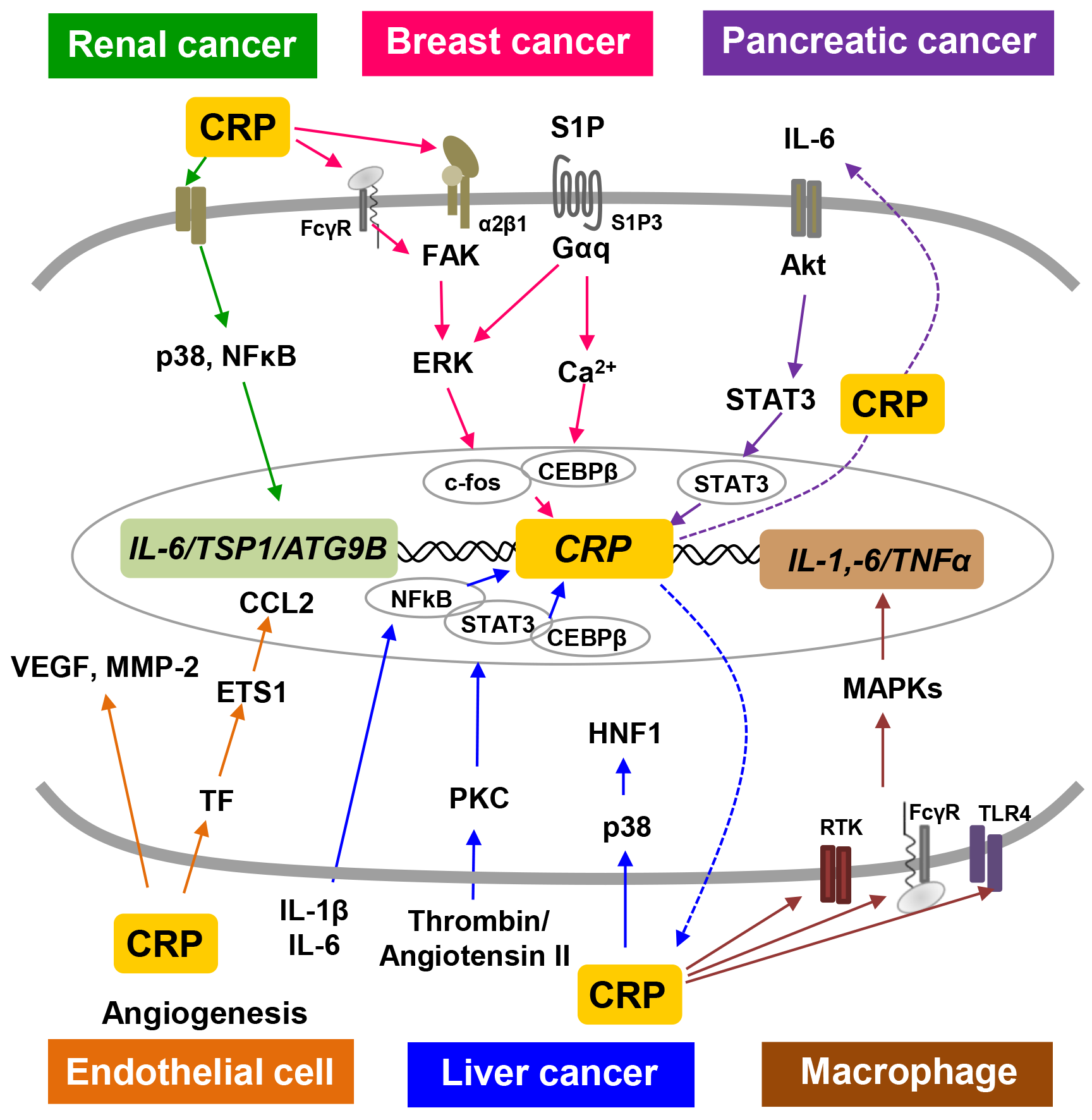
(Data source: Kim ES, et al. Biomol Ther. 2023)
Breast cancer is one of the most common malignancies in women. CRP is highly expressed and secreted in the highly invasive MDA-MB-231 TNBC (triple-negative breast cancer) cells. Knockdown of CRP reduces the proliferation, invasion, and tumor formation of MDA-MB-231 TNBC cells. CRP is involved in angiogenesis and tumor growth in TNBC cells. Elevated serum CRP levels are closely associated with breast cancer invasion, metastasis, and poor prognosis. Increased breast cancer risk is associated with weight gain and obesity in women, especially in postmenopausal women, and there is a significant correlation between CRP expression levels and body mass index (BMI). In inflamed breast tissue in obese women, levels of cyclooxygenase-2 (COX-2), which is involved in inflammation and prostaglandin synthesis, are elevated. Stimulation of COX-2 leads to elevated CRP levels. CRP plays an important role in its accumulation in the breast microenvironment during breast cancer progression.
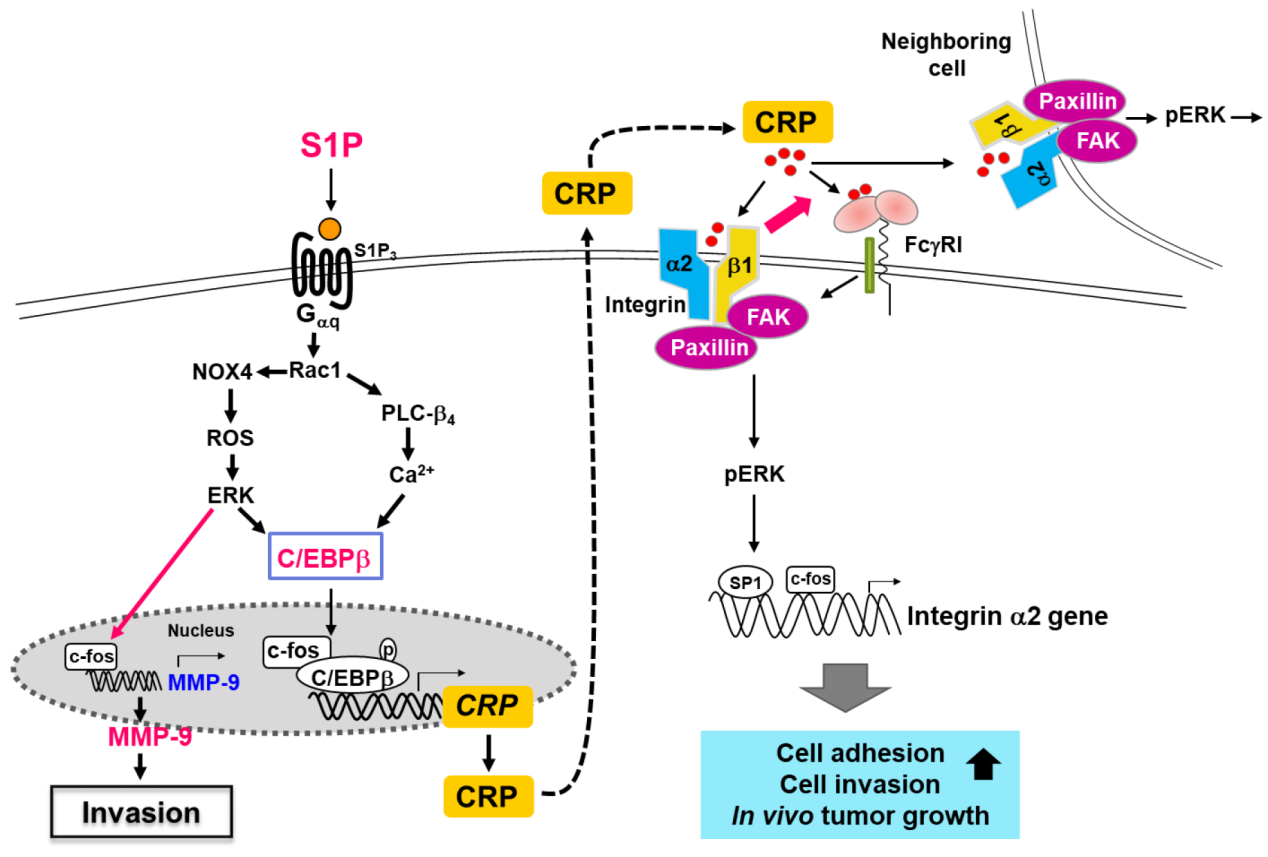
(Data source: Kim ES, et al. Biomol Ther. 2023)
CRP also plays a crucial role in vascular diseases such as atherosclerosis. CRP promotes the development and progression of atherosclerosis by promoting endothelial cell activation and macrophage recruitment. CRP primarily binds to cell membrane IgG FcγRs, leading to increased expression of macrophage chemoattractant protein 1 (MCP-1) and vascular cell adhesion molecule 1 (VCAM-1), thereby promoting the development of atherosclerosis. CRP also upregulates the production of reactive oxygen species (ROS) in endothelial cells, platelets, monocytes, and vascular smooth muscle cells through specific FcγRs. Inhibiting CRP may provide a new approach for the prevention and treatment of cardiovascular diseases.
CRP treatment strategies
Small molecule inhibitors: Develop small molecule inhibitors targeting the structural transformation of CRP, such as 1,6-bisphosphocholine (1,6-bisPC). This compound occupies the phosphocholine (PC) binding site of pCRP (pentameric CRP), preventing pCRP from binding to its main ligand PC, thereby inhibiting the CRP-induced inflammatory response.
Antisense oligonucleotides (ASOs): ASOs are used to target CRP mRNA at the transcriptional level, reducing basal CRP expression by highly selectively degrading the target mRNA or binding to sites on the mRNA that are critical for translation.
Therapeutic Apheresis: Using an extracorporeal device, such as the PentaSorb CRP affinity column, to highly selectively remove circulating pCRP from patient plasma, thereby reducing the exacerbated inflammation caused by pCRP*/mCRP (the pro-inflammatory form of CRP).
Monoclonal antibodies against mCRP: Developing monoclonal antibodies against mCRP (monomeric CRP) to inhibit mCRP-driven leukocyte activation and leakage is a novel therapeutic strategy.
Modulating CRP conformational changes: Based on the relationship between CRP structure and its biological function, developing new strategies to regulate the conformational changes of pCRP may provide direction for the development of new anti-inflammatory drugs.
CRP inhibition and depletion: CRP inhibition and depletion have been shown to be effective and feasible in multiple proof-of-concept studies, including the use of small molecule inhibitors, ASOs, or therapeutic blood purification to reduce CRP levels and thus reduce inflammation.

(Data source: Zeller J, et al. Pharmacol Ther. 2022)