CD45 is a receptor-type tyrosine protein phosphatase C (PTPRC), also known as leukocyte common antigen (LCA). It is a type I transmembrane glycoprotein expressed on almost all hematopoietic cells except mature red blood cells and is an important regulatory factor mediated by T and B cell antigen receptors.
CD45 distribution
CD45 is expressed on all T cells, B cells, and NK cells except plasma cells, as well as on monocytes, granulocytes, and macrophages, but not on mature erythrocytes and megakaryocytes.

(Data source: Uniprot)
CD45 forms multiple isoforms through different exon splicing, which play a key role in the proliferation and differentiation of stem cells. Different types of immune cells express different CD45 isoforms, which are used to distinguish different types of immune cells. This is a characteristic of the CD45 molecule and has been used as a diagnostic tool to distinguish different types of immune cells.

(Data source: Al Barashdi MA, et al. J Clin Pathol. 2021)
CD45 structure:
CD45 is a type I transmembrane protein composed of two cytoplasmic domains, a transmembrane domain, and an extracellular domain. It is a large glycoprotein ranging in size from 180 to 220 kDa and accounts for approximately 10% of positively expressed cell surface antigens. The cytoplasmic domain has a 79-amino acid C-terminal tail, a putative wedge-shaped domain, and two tandem PTPase domains. Although both domains are important in cellular physiology, only the D1 domain possesses enzymatic activity; the D2 domain, consisting of 19 amino acids, is phosphorylated by the C-terminal Src kinase. The overall structure of the D1 and D2 domains is very similar to that of another RPTP, the leukocyte common antigen-related protein (LAR). Both domains have essentially the same overall structure, consisting of a highly distorted nine-stranded mixed β-sheet.

(Data source: Nam HJ, et al. J Exp Med. 2005)
CD45 immune regulation and function
CD45 plays a crucial role in the immune system by regulating lymphocyte survival, cytokine responses, and T cell receptor signaling. It also influences various signaling pathways, including cytokine, NK receptor, Toll-like receptor, and Janus kinase (JAK) signaling. In mast cells, CD45 acts as a JAK phosphatase to regulate antigen-triggered Fc receptor and cytokine signaling, while DCs require CD45 to regulate TLR signaling, thus expanding the role of CD45 to recognize other receptors involved in adaptive and innate immunity. CD45 can antagonize dephosphorylation of the kinase domain phosphotyrosine (Y394 in p56LCK) as well as the C-terminal phosphotyrosine (Y505 in p56LCK). The kinase is inactivated by dephosphorylation of the kinase domain (Y394) and activated by dephosphorylation of the C-terminal site (Y505).
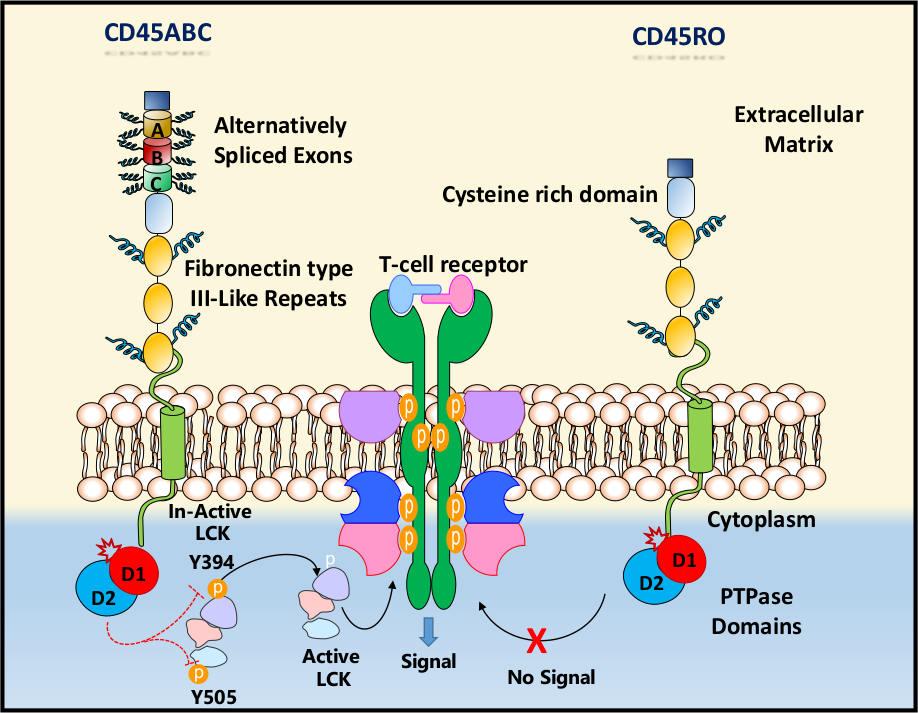
(Data source: Al Barashdi MA, et al. J Clin Pathol. 2021)
CD45 plays both negative and positive regulatory roles in T and B cell activation, influencing the interaction between T cells and macrophages. CD45 is crucial for regulating innate immune signaling and has been implicated in a variety of diseases, including autoimmune hepatitis, HIV infection, multiple sclerosis, leukemia, and lymphoma.
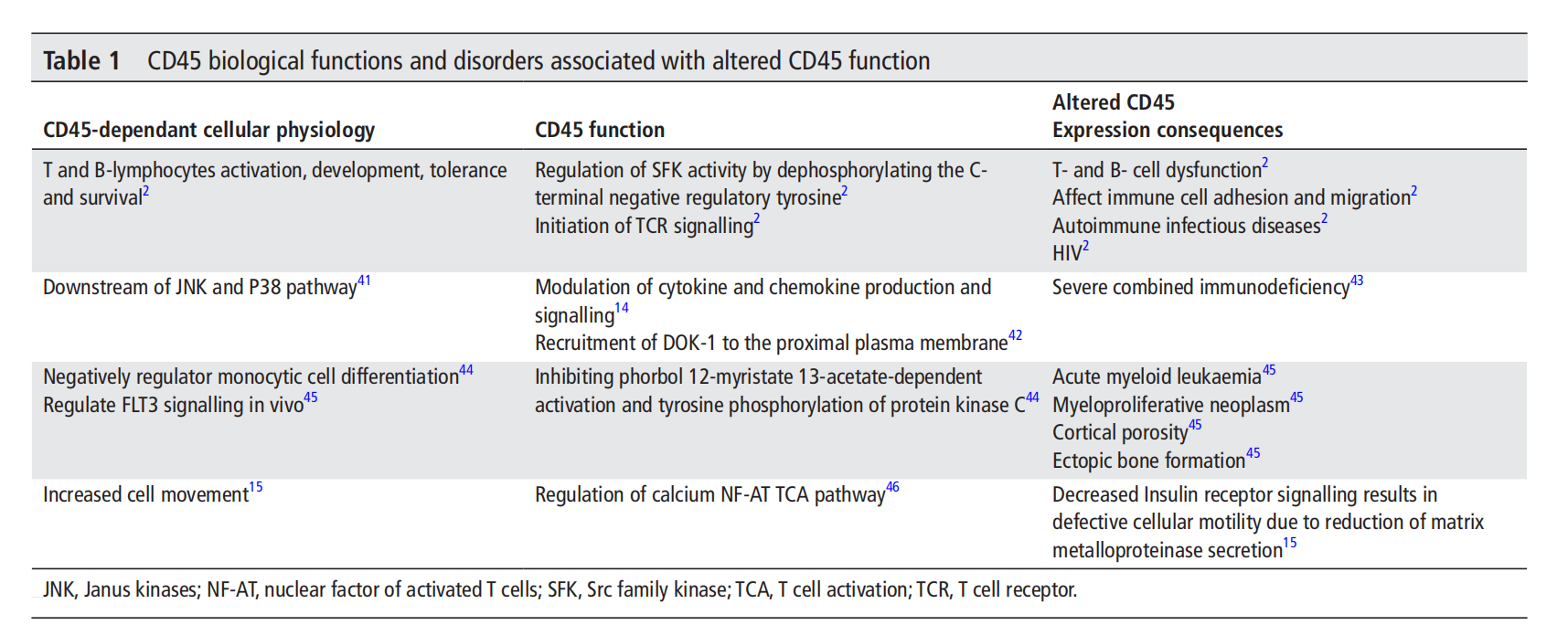
(Data source: Al Barashdi MA, et al . J Clin Pathol. 2021)
Clinical value of CD45
CD45-targeted antibody-drug conjugates (CD45 ADCs): As a single-agent dose, CD45 ADCs have successfully achieved 100% donor chimerism in allogeneic hematopoietic stem cell transplantation without the need for additional immunosuppressants, providing a novel conditioning approach for hematopoietic stem cell transplantation. Clinical translation of CD45 ADCs requires novel agents that can successfully target human CD45 without causing significant toxicity, and the current development of therapeutic antibodies offers a promising path forward for this platform. Clinical application of CD45 ADCs is expected to achieve immune preservation after transplantation, providing patients with improved post-transplant immune function.

(Data source: Zhanzhuo Li , et al . Blood. 2022)
CAR-T therapy targeting CD45: The clinical value of CD45 in blood cancers lies in the fact that it is an antigen that is ubiquitously present on almost all white blood cells, leukemias, and lymphomas, making it an attractive target for universal blood cancer immunotherapy. By targeting CAR T cells with CD45, researchers hope to develop a single treatment approach that can be used to treat a variety of hematological malignancies, potentially accelerating clinical development and improving treatment outcomes. Studies have shown that CD45 is a viable target for CAR T cell therapy, and experiments on patient-derived acute myeloid leukemia, B-cell lymphoma, and acute T-cell leukemia have demonstrated the potential of targeting CD45 in blood cancers.

(Data source: Wellhausen N, et al. Sci Transl Med. 2023)