IL13 is interleukin 13, a pleiotropic cytokine that is mainly secreted by activated TH2 cells. IL13 plays a key role in diseases such as asthma, dermatitis, and cancer.
IL13 production and function
IL-13 is primarily secreted by activated TH2 cells and is also produced by basophils, eosinophils, mast cells, natural killer cells, epithelial cells, smooth muscle cells, fibroblasts, and NK cells. IL-13 can also regulate the functions of IL-13+ILC2, mast cells, macrophages, eosinophils, and B cells. IL-13 can directly act on macrophages, driving their differentiation toward an M2 phenotype, thereby generating a Th2 response. Furthermore, IL-13 drives beneficial responses such as IgE isotype switching, eosinophil recruitment, mucus production, and muscle contraction.

(Data source: Marone G, et al. Front Pharmacol. 2019)
IL13 receptors and signaling pathway regulation
The diverse functions of IL-13 are mediated by a complex receptor system, including the IL-4 receptor α (IL-4Rα; CD124) and two other homologous cell surface proteins, IL-13 receptor α1 (IL-13Rα1; CD213a1) and IL-13 receptor α2 (IL-13Rα2; CD213a2). IL-4 signals through both type I and type II receptors, while IL-13 signals exclusively through the type II receptor. Binding of IL-4 and IL-13 to their receptors activates tyrosine kinases such as JAK1, JAK2, JAK3, and TYK2, leading to the phosphorylation and activation of STAT6 and STAT3. Activated STAT transcription factor dimers enter the nucleus to regulate the expression of downstream genes. Under certain circumstances, IL-13 signaling through IL-13Rα2 leads to the phosphorylation of ERK1/2 in a STAT6-independent manner, forming the dimeric transcription factor AP-1. Phosphorylated AP-1 translocates to the nucleus and binds to specific DNA elements.

(Data source: Marone G, et al. Front Pharmacol. 2019)
IL13 and disease
IL-13 and its receptors are involved in regulating allergic inflammation and are implicated in the pathogenesis and treatment of cancer, asthma, and allergic diseases. IL-13 plays a key role in skin barrier dysfunction, skin flora imbalance, inflammatory cell infiltration, skin fibrosis, and pruritus, making it a key cytokine in the pathogenesis of atopic dermatitis.
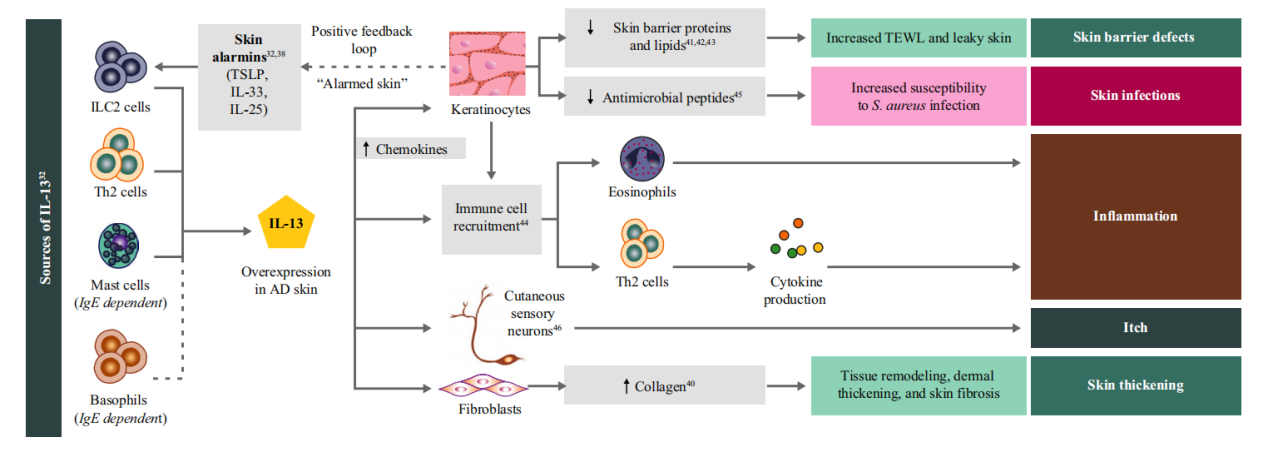
(Data source: Bieber T. Allergy. 2020)
IL13 targeted therapy strategies
Monoclonal antibody therapy: There are currently four selective IL-13 inhibitors that are in different stages of development or approval. Dupilumab, a humanized IgG4 monoclonal antibody that can simultaneously block the IL-4 and IL-13 signaling pathways, has been approved for patients with type 2 asthma and atopic dermatitis.
Lebrikizumab is a fully human IgG4 that binds to IL-13 and prevents the formation of the IL-13Rα1/IL-4Rα heterodimeric receptor signaling complex and can be used to treat atopic dermatitis.
Tralokinumab is a fully human IgG4λ that binds to IL-13 and prevents it from binding to the IL-13 receptor. It has been approved by the European Union and the US Food and Drug Administration for the treatment of patients with moderate to severe atopic dermatitis.
Eblasakimab is a monoclonal antibody that targets IL13Rα1 to block IL-13 signaling and can be used to treat atopic dermatitis.

(Data source: Lytvyn Y, et al. Pharmaceutics. 2023.)