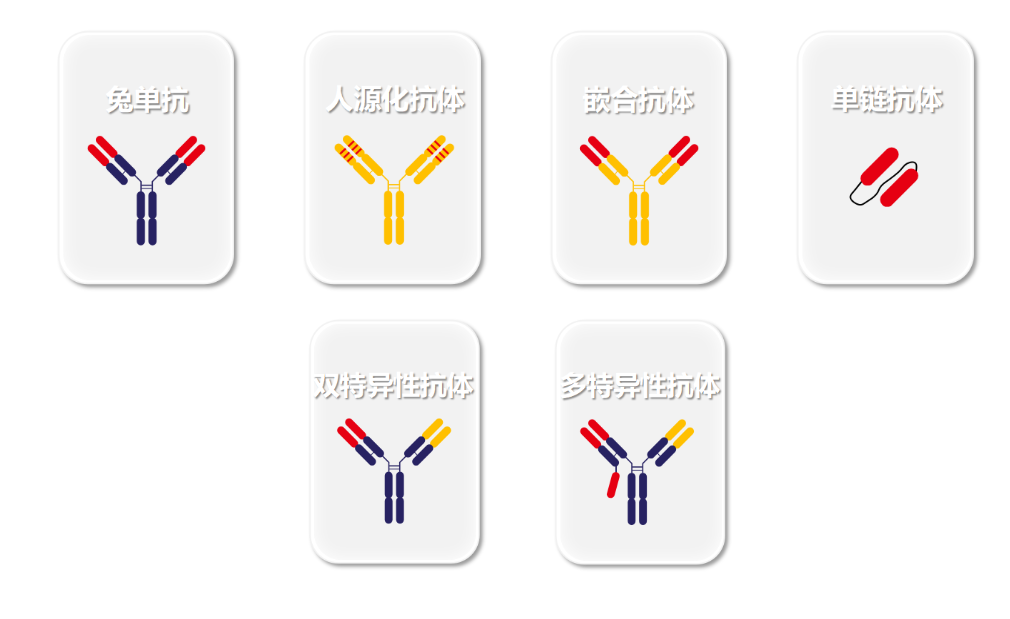
Antibodies can be synthesized through a variety of strategies, starting with polyclonal antibodies produced through animal immunization, followed by monoclonal antibodies produced through various screening platforms, such as hybridomas, phages, and single B cells. The third generation of recombinant antibody technology involves cloning antibody genes from hybridomas, sequencing them by mass spectrometry, and then using recombinant DNA technology to produce recombinant antibodies. Recombinant antibodies offer advantages such as batch-to-batch consistency, sustainable production, low market prices, and freedom from animal ethics issues. Furthermore, with the advancement of machine learning and artificial intelligence, researchers can use various AI models to predict the potential sequence and structure of antibodies, increasing the discovery and success rates of antibodies.

(Data source: Gray A. et al. Nat Biotechnol. 2020)
Antibody sequencing- driven recombinant antibody expression
With the continuous development of antibody engineering, the widespread application of antibody mass spectrometry sequencing, single-cell sequencing, and hybridoma sequencing has provided more means and approaches for antibody research and application. By directly obtaining sequence information of effective antibodies from the terminal, the development cycle is greatly shortened, and the sequence can be further modified to improve performance at a later stage. This has completely changed the development of diagnostic antibodies and, in turn, the development of therapeutic antibodies.

(Data source: Snapkov l, et al. Trends Biotechnol. 2022)
Artificial intelligence aids antibody development
Deep machine learning and AI algorithms enable the design of antibodies from scratch, significantly improving the speed and accuracy of antibody discovery. On October 9, 2024, half of the 2024 Nobel Prize in Chemistry was awarded to David Baker for his contributions to computational protein design; the other half was jointly awarded to Demis Hassabis and John M. Jumper for their contributions to protein structure prediction.
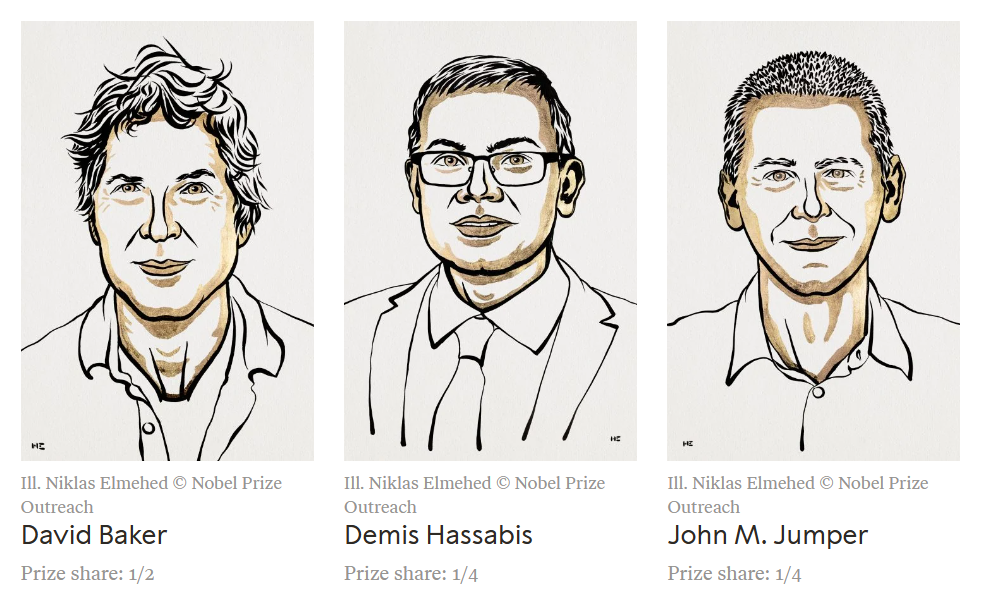
In 2020, Demis Hassabis and John Jumper launched an AI model called AlphaFold2. With its help, they have been able to predict the structures of nearly all of the 200 million proteins identified by researchers. This AI model now allows researchers to better understand antibiotic resistance and create images of enzymes that can break down plastic.

David Baker used computer software to develop and design a completely new protein from scratch. The Rosetta platform he developed can predict the three-dimensional structure of proteins and also supports the de novo design of new proteins that do not exist in nature, including proteins that can be used as drugs, vaccines, nanomaterials and microsensors.

(Data source: https://www.nobelprize.org/prizes/chemistry/2024/summary/)
Through machine deep learning, antibody/protein sequences and structures can be transformed and optimized to obtain more formats of antibodies, bringing more opportunities for antibody development.
Antibody sequence optimization: Using deep learning models, researchers can predict the impact of antibody variants on their affinity and specificity, thereby guiding the design of more effective antibody sequences.
Structure prediction: AI models are able to predict the three-dimensional structure of a protein based on its known sequence, which is crucial for understanding how an antibody binds to its specific antigen.
Affinity improvement: By analyzing large amounts of antibody-antigen interaction data, neural networks can discover design principles for improving antibody affinity.
Antibody property prediction: In addition to binding specificity and affinity, developability is crucial for the development of novel antibody therapeutics. Developability attributes influence the likelihood that an antibody candidate will advance to clinical use with appropriate efficacy. Key developability attributes include intrinsic immunogenicity, aggregation/insolubility, viscosity, and half-life.
Several databases of antibody sequences, structures, and their properties have been published, enabling the subsequent development of computational methods.

(Data source: Kim J, et al. Trends Pharmacol Sci. 2023)
Recombinant Antibody Expression Platform Service Features
Wuhan Mabnus Biotechnology Co., Ltd. has many years of experience in recombinant antibody engineering and recombinant expression. Relying on mammalian cell expression platforms, combined with database analysis and molecular construction design, it can produce low-cost, high-yield engineered recombinant antibodies.