Fibroblast activation protein (FAP) is a serine protease with dual enzymatic activity that is overexpressed in various tumor types and in different types of cancer-associated fibroblasts (CAFs), while expression is minimal in healthy adult tissues. FAP overexpression in CAFs is associated with poor prognosis and plays a crucial role in tumor initiation, progression, and invasion. Therefore, FAP is considered an important therapeutic target for cancer treatment.

(Data source: Shahvali S, et al. Drug Deliv Transl Res. 2023)
Cancer-associated fibroblasts (CAFs)
CAFs define a complex mesenchymal cell population with heterogeneous characteristics that are distinct from normal fibroblasts. The origin of CAFs may be fibroblasts, endothelial cells, epithelial cells, adipocytes, bone-arrow-derived mesenchymal stem cells, hematopoietic stem cells, tumor stem cells, pericytes, and stellate cells. CAFs are the most important components of the tumor microenvironment and can enhance cancer cell proliferation, metastasis, angiogenesis, induction of chemoresistance, and invasion through multiple mechanisms. Compared with remodeling fibroblasts, CAFs have degenerate branched cytoplasm and indented nuclei, and have enhanced migration, proliferation, and secretory characteristics. CAFs are more active in metabolic function than quiescent fibroblasts. FAP, one of the hallmark protein markers expressed by CAFs, has become a promising therapeutic target.

(Data source: Yang D, et al. Exp Mol Med. 2023)
The structure and role of FAP in cancer
FAP is a 170 kDa homodimeric type II transmembrane protein with two N-terminal glycosylated subunits. It belongs to the dipeptidyl peptidase (DPP) subfamily and the protoglycopeptidase family. It can act independently of its enzymatic activity. Highly expressed FAP in tumor cells exhibits both enzymatic (DPP and catalytic) and non-enzymatic activities, influencing signaling pathways and promoting cell growth, invasion, and angiogenesis.

(Data source: Xin L, et al. Front Oncol. 2021)
Targeted immunotherapy for FAP:
Current FAP-targeted immunotherapies include anti-FAP antibodies and antibody conjugates (ADCs) , FAP chimeric antigen receptor (CAR)-T cells , and various FAP vaccines.

(Data source: Shahvali S, et al. Drug Deliv Transl Res. 2023)
Antibodies and Antibody Conjugates
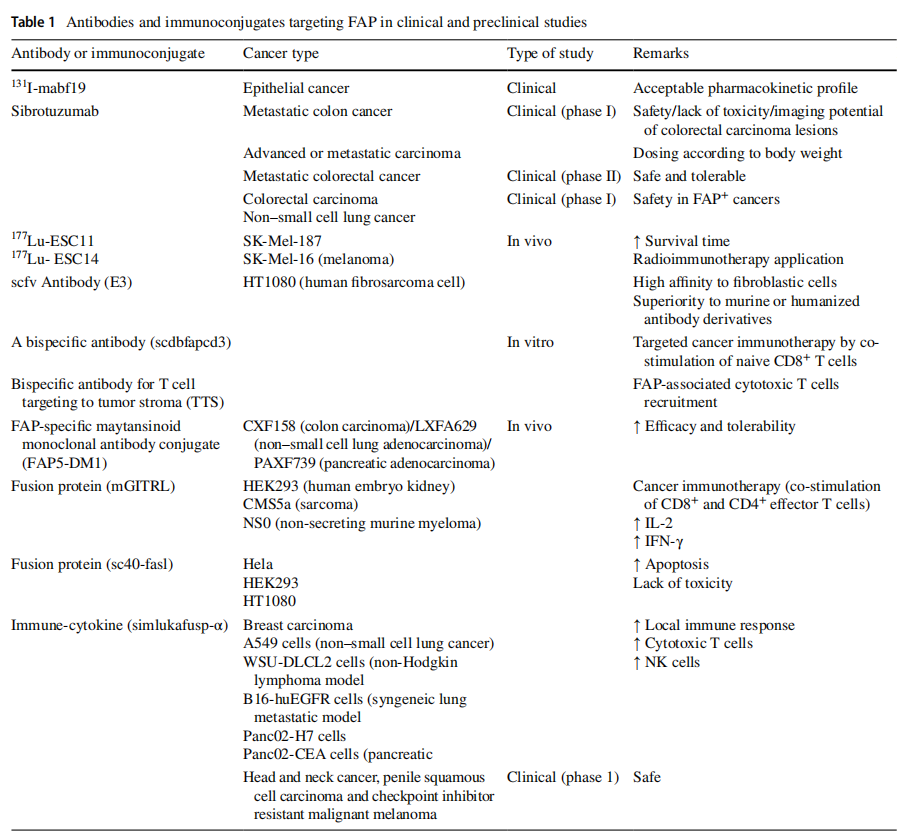
Early research on monoclonal antibodies targeting FAP focused on identifying FAP (the f19 clone) without considering their potential therapeutic effects. However, radiolabeled f19 demonstrated high FAP expression in tumors and metastases, with amelioration of clinical symptoms. This supported the potential diagnostic and therapeutic role of antibodies targeting FAP. Subsequently, several humanized versions of f19 antibodies were developed and evaluated for their diagnostic and therapeutic properties in mouse models. Additionally, high-affinity FAP-scFv antibodies (E3), FAP and CD3 bispecific antibodies, FAP antibody and 4-1BB fusion proteins, and various antibody conjugates have been used to target FAP, demonstrating immunostimulatory and anti-cancer effects.
Chimeric antigen receptor (CAR) T cells
In the context of CAR-T targeted therapy, FAP appears to be a promising CAF marker, and several studies have focused on targeting FAP with potential antitumor activity in preclinical models (both preclinical studies and clinical trials). CAR-T cells (CD8+) can successfully kill FAP-expressing malignant pleural mesothelioma (MPM) lines and prolong the overall survival of MPM mouse models. Currently, some projects have entered the early clinical stage.

Vaccine
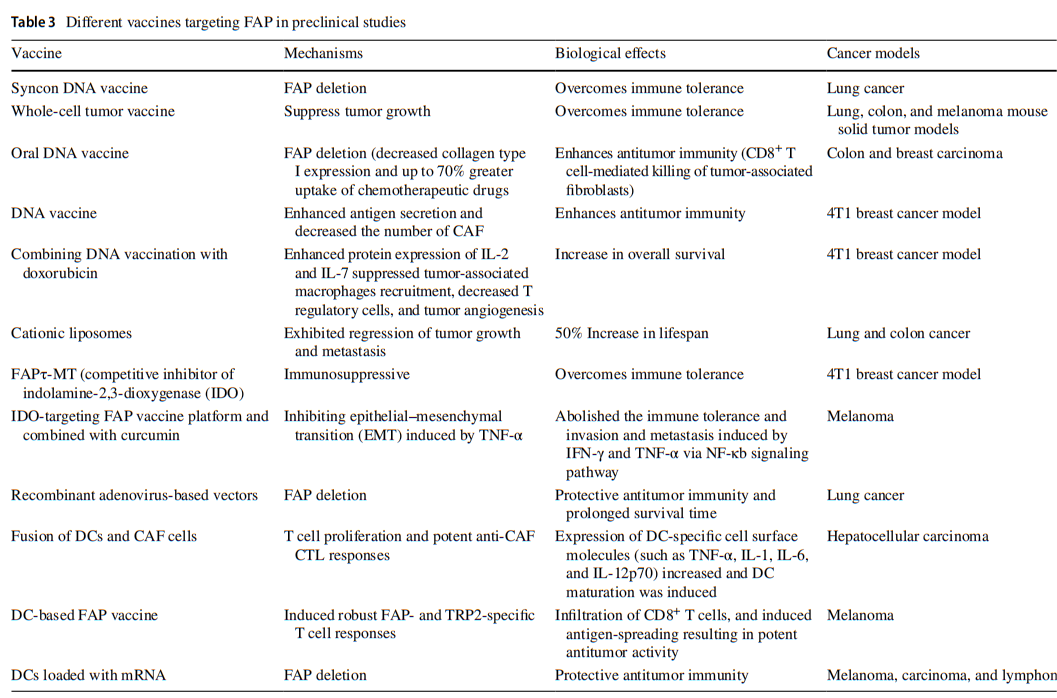
Another strategy leveraging FAP expression is the development of vaccines targeting FAP. It is well known that the immunosuppressive tumor microenvironment limits the effectiveness of cancer vaccines. CAF-targeted vaccines can reverse this immunosuppressive tumor microenvironment and exert anti-tumor effects by reducing tumor cell apoptosis. Various FAP-targeting vaccines, ranging from DNA and whole-cell tumor cell vaccines to dendritic cell (DC)-based vaccines, are advancing into clinical trials.
Summary:
Over the past 30 years, studies have demonstrated that FAP is a key marker of stromal cells with important functions within the tumor microenvironment, likely contributing to their tumorigenicity. FAP may even directly promote the malignant phenotype of transformed cells through both enzyme activity-dependent and non-hydrolytic mechanisms. As a broad-spectrum target, FAP's value in tumor diagnosis and treatment cannot be ignored. More importantly, FAP has gained recognition and attention as a novel strategy for targeting the tumor microenvironment.