4-1BB is a T cell co-stimulatory immune checkpoint molecule also known as CD137 or TNF receptor superfamily member 9 (TNFRSF9). The interaction between 4-1BB and its primary ligand, 4-1BBL, positively regulates T cell immunity, mediating T cell survival and proliferation. Targeting 4-1BB with agonistic antibodies is a promising immuno-oncology approach, making it an attractive target for the development of cancer immunotherapy.
4-1BB expression
4-1BB expression is primarily found on the surface of activated cytotoxic CD8+ T cells and helper CD4+ cells. Activated T cells can induce 4-1BB expression on NK cells, B cells, monocytes, and DCs.
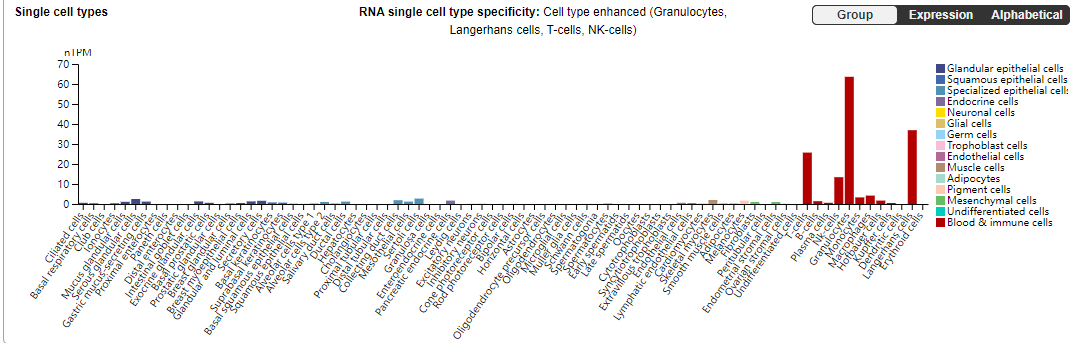
(Data source: uniprot)
The structure of 4-1BB
4-1BB is a type I transmembrane protein composed of four cysteine-rich domains (CRDs) forming an extracellular domain, a short helical transmembrane domain, and a cytoplasmic signaling domain. 4-1BB's ligand, 4-1BBL, typically exists as a homotrimer. Human 4-1BBL exists as a homotrimer on the cell membrane, while mouse 4-1BBL exists as a covalently linked dimer.

(Data source: Singh R, Kim YH, Lee SJ, Eom HS, Choi BK. Exp Mol Med. 2024)
4-1BB signaling pathway and regulation:
Interaction between 4-1BB on the T cell surface and 4-1BBL on APCs recruits TNFR-associated factors 1 and 2 (TRAF1 and TRAF2) to the TRAF binding motif located on the cytoplasmic tail of 4-1BB. TRAF proteins form homo- or heterotrimers and act as scaffolding proteins. TRAF1 and TRAF2 trimers mediate co-stimulatory signals that recruit ubiquitin ligases and cell inhibitor of apoptosis 1 or 2 (cIAP1/2), thereby activating downstream signaling pathways: NF-κB, ERK, MAPK, and JNK pathways. Signaling through these pathways leads to increased expression of the anti-apoptotic proteins Bfl-1 and Bcl-xL, decreased expression of the pro-apoptotic protein Bim, and enhanced T cell proliferation, differentiation, effector function, and survival.

(Data source: Kim AMJ, et al. Front Oncol. 2022)
In NK cells, 4-1BB signal transduction can enhance NK cell proliferation and lead to increased production of cytokines such as IFN-γ, which in turn stimulates T cells, especially CD8+ T cells, promoting cell proliferation, cytokine production and activity.
In monocytes, 4-1BB signaling activates cells and enhances their proliferation and survival. Following stimulation by its ligands and subsequent activation of monocytes, 4-1BB signaling generates a proinflammatory response, increasing TNF-α and IL-8 while decreasing IL-10 secretion.
4-1BB signaling in DCs upregulates B7-1 and B7-2 and increases DC secretion of IL-6 and IL-12. Activating 4-1BB signaling on DCs by administering agonist 4-1BB antibodies may also enhance their role in stimulating T cell responses.
Targeted therapy of 4-1BB
Targeting 4-1BB with agonistic antibodies is a promising immuno-oncology approach, playing a crucial role in immune regulation. Agonistic anti-4-1BB mAb therapy induces T cell proliferation and cytokine secretion. In the case of natural killer (NK) cells, 4-1BB stimulation enhances ADCC. Agonistic anti-4-1BB mAbs can also stimulate dendritic cells (DCs) and macrophages to induce anti-tumor immune responses. 4-1BB is expressed in tumor-associated vascular endothelium. Bispecific antibodies that simultaneously target 4-1BB and tumor antigens (such as HER2) can bring immune effectors and target cells into close proximity and promote tumor cell lysis.

(Data source: Chester C, Sanmamed MF, Wang J, Melero I. Blood. 2018)
Currently, there are a large number of monoclonal antibodies targeting 4-1BB in clinical development, among which Urelumab and utomilumab are the first- generation 4-1BB agonists.
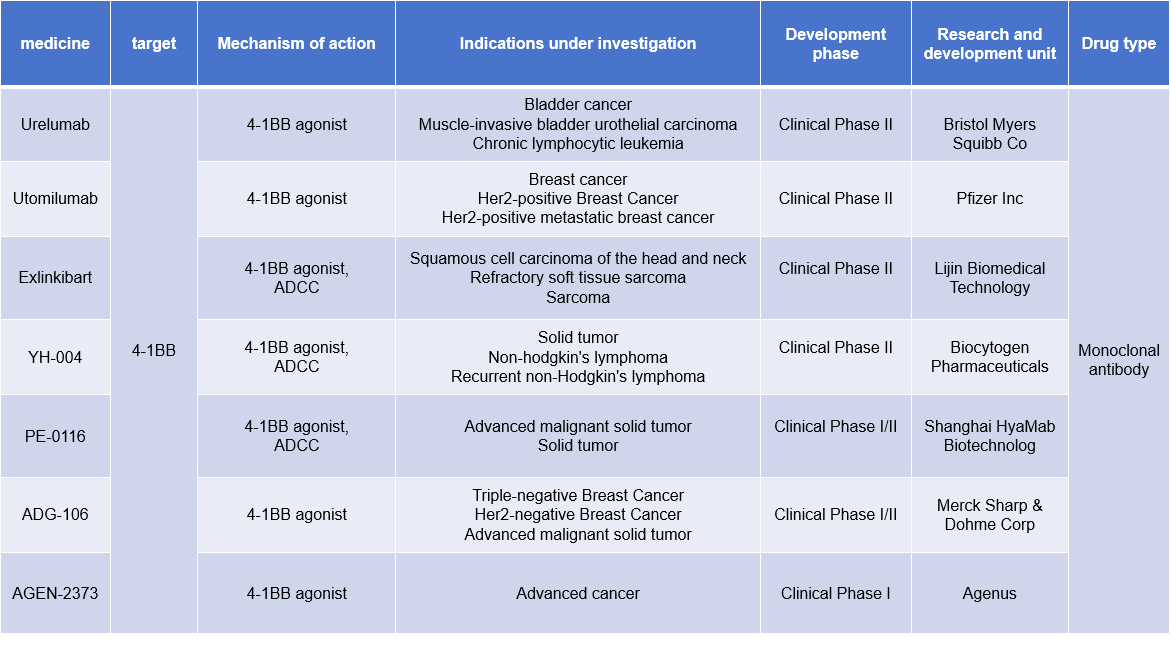
(Data source: New Drug Intelligence Database)
Urelumab (BMS-663513), a humanized anti-4-1BB IgG4 antibody developed by Bristol Myers Squibb, is being developed for the treatment of bladder cancer, muscle-invasive urothelial bladder carcinoma, chronic lymphocytic leukemia, and other diseases. Urelumab binds to the 4-1BB receptor CRD1 in a non-4-1BB competitive manner. This activation is systemic but can be further enhanced by hypercrosslinking via FcγRIIB binding. However, in this process, urelumab competes with endogenous IgG for FcγRIIB binding.
Utomilumab (PF-05082566) is a fully human anti-human 4-1BB IgG2 antibody developed by Pfizer. Utomilumab binds to CRD2 and CRD3, competing with 4-1BBL. Only when utomilumab is hypercrosslinked via FcγRIIb does it lead to full hypercrosslinking and activation of the 4-1BB receptor. Therefore, utomilumab competes with soluble membrane-bound 4-1BBL for binding to the 4-1BB receptor and with endogenous IgG for binding to FcγRIIB.

(Data source: Claus C, et al. MAbs. 2023)
Exlinkibart (LVGN6051), a 4-1BB-targeting monoclonal antibody developed by Lyvgen Biopharma, is currently in Phase II clinical trials for the treatment of head and neck squamous cell carcinoma, refractory soft tissue sarcomas, and other diseases. Upon administration, LVGN6051, an anti-CD137 agonist antibody, binds to and activates CD137 expressed on various leukocyte subsets, including activated T lymphocytes and natural killer (NK) cells. This enhances CD137-mediated signaling, induces cytokine production, and promotes T cell-mediated anti-tumor immune responses.
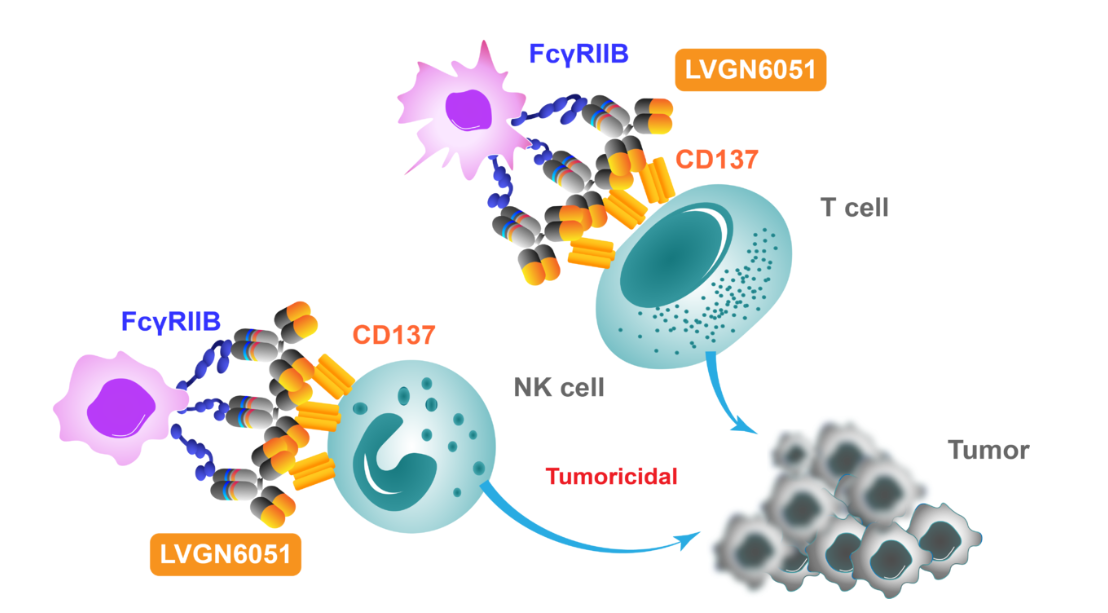
(Data source: Lyvgen Biopharma official website)
Subsequently, other types of agonists targeting 4-1BB, such as bi-, tri- or tetra-specific molecules, have emerged and are in clinical development.
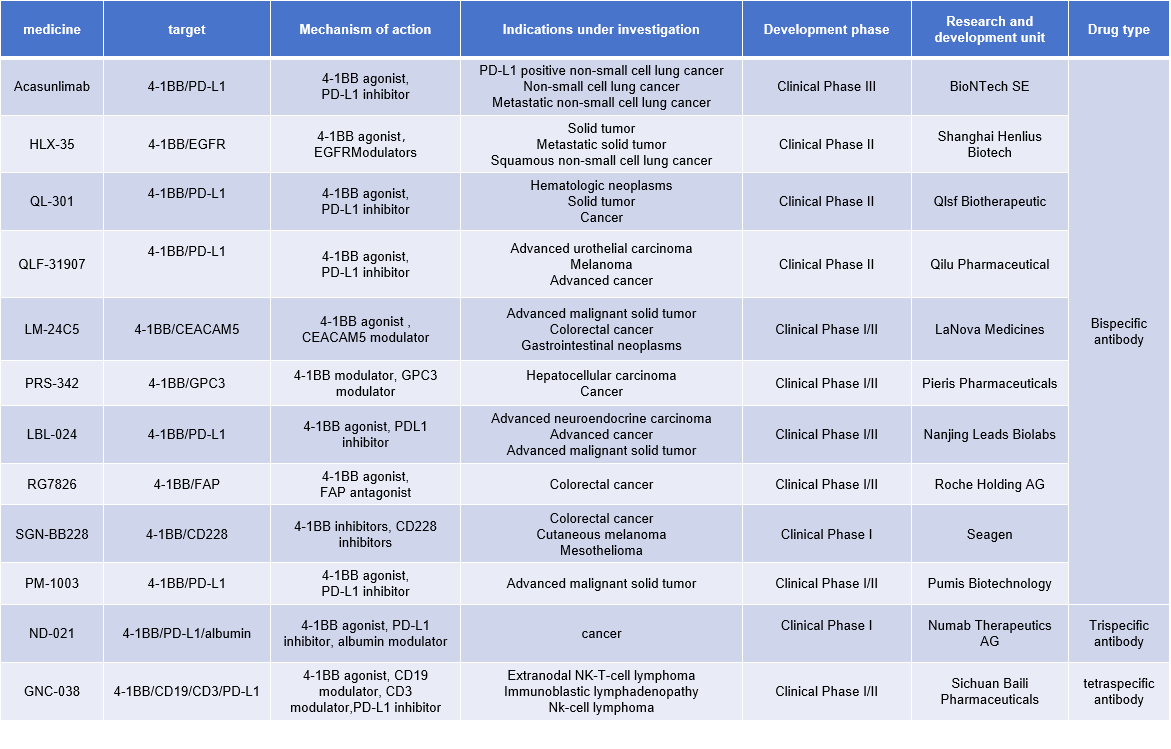
(Data source: New Drug Intelligence Database)
LBL-024, a bispecific antibody targeting 4-1BB and PD-L1, is being developed by Nanjing Leads Biolabs for the treatment of advanced neuroendocrine cancer, advanced cancers, and advanced malignant solid tumors. It is in Phase 1/2 clinical trials. LBL-024 targets PD-L1, relieving PD-1/PD-L1 immunosuppression. Simultaneously, through 4-1BB co-stimulation, it effectively recruits, activates, and expands T cells in the tumor microenvironment, synergistically enhancing the anti-tumor immune response. On October 9, 2024, Welly Zhibo announced significant progress in this drug. LBL-024 is indicated as a monotherapy for the treatment of patients with advanced extrapulmonary neuroendocrine carcinoma (EP-NEC) who have progressed after two or more lines of chemotherapy. LBL-024 received Breakthrough Therapy Designation based on its demonstrated clinical efficacy and favorable safety profile in this population. Clinical data to date show that LBL-024 monotherapy has more than doubled the objective response rate (ORR) and overall survival (OS) compared to existing treatments.

(Data source: Nanjing Leads Biolabs Co., Ltd. official website)
PM-1003 is a bispecific antibody targeting 4-1BB and PD-L1, developed by Biotheus. It is currently in Phase 1/2 clinical trials for the treatment of advanced malignant solid tumors.
GNC-038 is an octavalent, tetraspecific T-cell engager developed by Sichuan Biokin Pharmaceutical that targets 4-1BB/CD19/CD3/PD-L1 and is designed to target CD19-expressing B-cell malignancies. This molecule is the first tetraspecific therapeutic antibody tested in human trials. It is in Phase 1 clinical development for the treatment of diseases such as lymphoma and leukemia. The GNC-038 molecule can bind to both CD3 and CD19, redirecting T-cell cytotoxicity to specific cancer indications defined by CD19 expression. The molecule can also shift T-cell cytotoxicity toward cells with high PDL1 expression, suggesting its potential to convert adaptive drug resistance in cancer cells into drug sensitivity. GNC-038 can also bind to 4-1BB in a non-cytolytic manner, transducing guidance signals to T cells, thereby enhancing their function throughout the continuous dosing cycle of treatment.
Sichuan Biokin Pharmaceutical has also developed two other tetraspecific antibodies targeting 4-1BB, GNC-035 and GNC-039.

(Data source: systimmune official website)