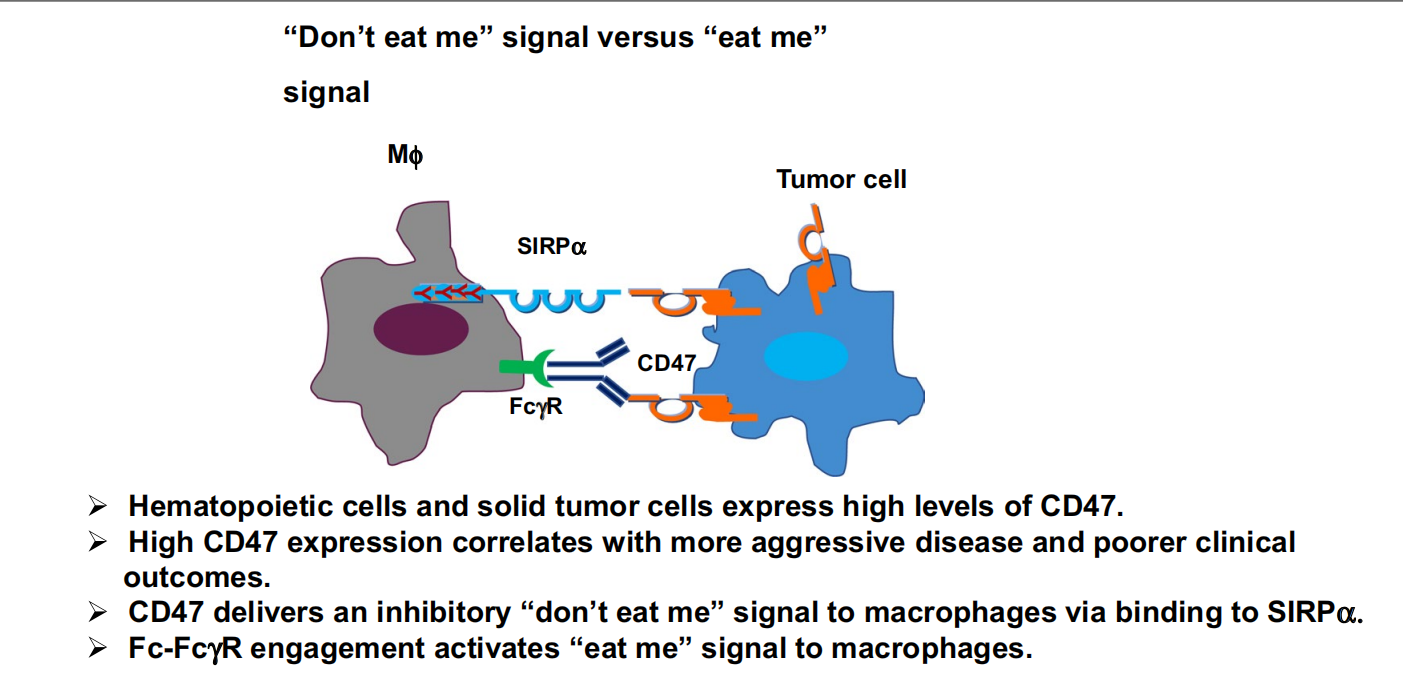
The leukocyte surface antigen CD47, also known as MER6 or IAP, is a ligand for signal regulatory protein α (SIRPα). Its extracellular domain (ECD) is a cell surface self-marker that binds to SIRPα and inhibits macrophage phagocytosis, thereby inhibiting macrophage phagocytosis and protecting CD47-expressing cells from phagocytosis. Cancer immunotherapy approaches in clinical trials primarily target blocking the CD47/SIRPα interaction. CD47 has become a key checkpoint in cancer immunotherapy, acting as a "don't eat me" signal and suppressing innate immune signaling. The CD47-SIRPα axis is considered a promising therapeutic target for various diseases and stem cell therapies.
(Data source: Jiang Z, et al. J Hematol Oncol. 2021)
Expression distribution of CD47
CD47 is a multifunctional cell surface molecule that is widely expressed on immune cells including dendritic cells (DCs), macrophages, monocytes, and T cells. SIRPα is abundantly expressed on neurons, macrophages, DCs, and neutrophils. However, SIRPα is barely detectable on red blood cells (RBCs) or T or B lymphocytes.

(Data source: Uniprot)
Structure of CD47
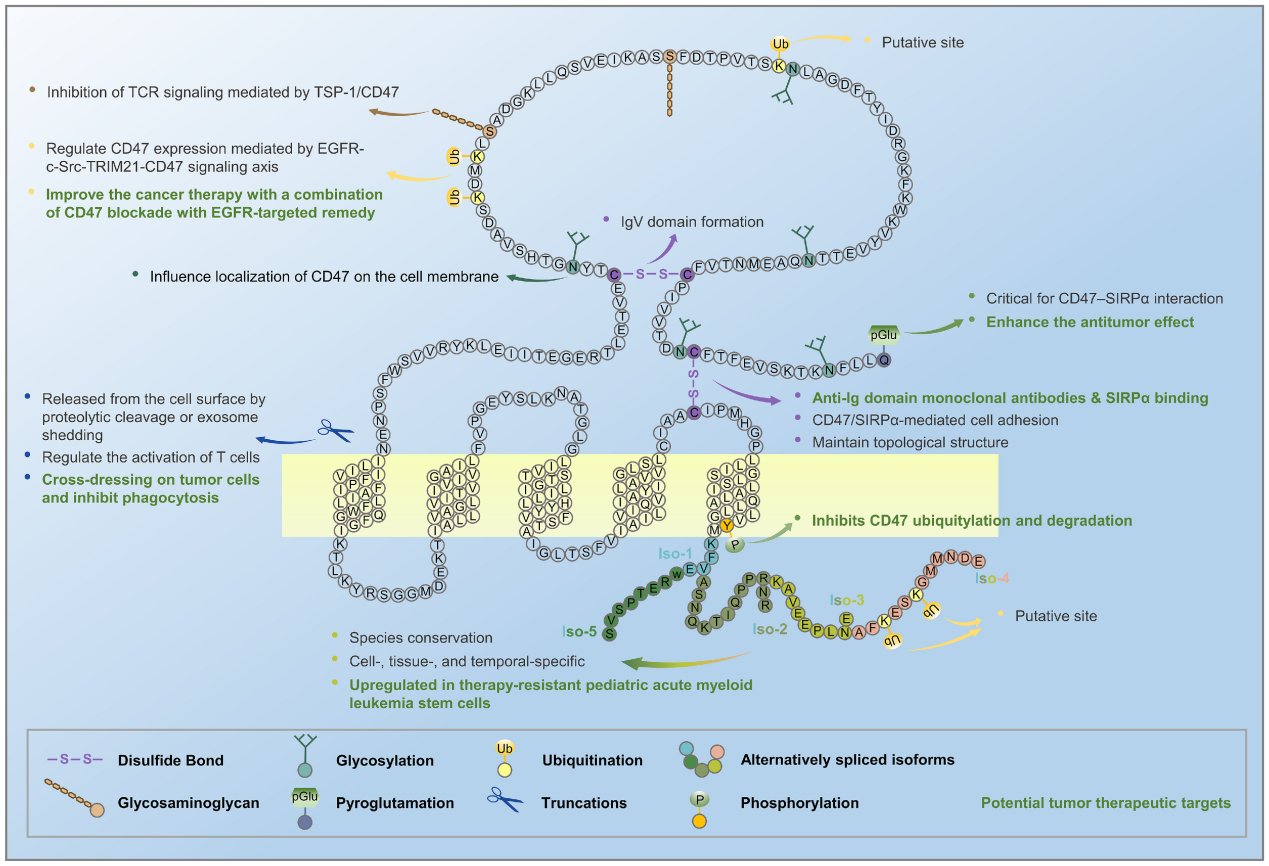
CD47 is the only five-transmembrane (5-TM) receptor in the immune system. It consists of an N-terminal extracellular immunoglobulin-like (IgV) domain, five transmembrane regions with a short loop in between, a short C-terminal cytoplasmic tail, and an 18-amino acid N-terminal signal peptide. Alternative splicing and post-translational modifications of CD47 produce multiple forms of the CD47 protein. CD47 mRNA undergoes alternative splicing to form five isoforms, and the CD47 protein undergoes post-translational modifications such as glycosylation, glycosaminoglycans, pyroglutamate, proteolytic cleavage, and exosomal shedding.
Currently, there are three known natural ligands for CD47: integrin, thrombospondin-1 (TSP-1), and signal regulatory protein α (SIRP).
The extracellular N-terminal IgV domain of CD47 is crucial for interacting with signal regulatory protein α (SIRPα) on the surface of macrophages.
(Data source: Zhang T, Wang F, Xu L, Yang YG. Front Immunol. 2024)
The role of CD47 in the immune system
CD47 is essential for innate and adaptive immune responses as a self-recognition marker, inhibiting phagocytosis by signaling a "don't eat me" response.
The role of CD47 in innate immunity
Macrophages: CD47 directly binds to SIRPα in macrophages, sending a "don't eat me" signal that protects cancer cell immune clearance. CD47 is considered a novel and effective macrophage immune checkpoint for cancer immunotherapy.
NK cells: CD47 regulates the proliferation, activation, and recruitment of NK cells; treatment of NK cells with CD47 inhibitors that block TSP-1 binding results in its inhibitory effect on NK cell proliferation.
Dendritic cells (DCs): CD47 can regulate the migration, maturation, activation and apoptosis of dendritic cells (DCs).
Neutrophils: CD47 plays a crucial role in neutrophil migration to sites of injury. CD47 on epithelial cells, bound to SIPRα on neutrophils, regulates neutrophil adhesion and facilitates their infiltration through the vascular endothelium into tissue spaces. Disruption of CD47 or its binding signaling pathways reduces neutrophil migration and infiltration.
The role of CD47 in adaptive immunity
T cells: CD47 regulates T cell activation, differentiation, proliferation, and apoptosis. TSP-1 binds to CD47 to inhibit T cell activation. The interaction of CD47 on T cells and SIRPα on DCs promotes T cell proliferation, while inhibition of SIRPα and CD47 reduces T lymphocyte proliferation. The interaction of CD47 with TSP-1 or blocking CD47 induces T cell apoptosis.
Regulatory T cells: CD47 on Tregs regulates the generation, proliferation and differentiation of Treg cells through interaction with its receptor SIRPα or TSP-1, and in this way contributes to the neuroprotection of Tregs.
B cells: The interaction between CD47 on B cells and SIRPα on macrophages and dendritic cells results in cell-cell interactions that are essential for B cell maturation.

(Data source: Liu Y, Weng L, Wang Y, et al. J Adv Res. 2024)
CD47-targeted therapy
CD47 transmits inhibitory signals through SIRPα on macrophages and other myeloid cells. High CD47 expression is positively correlated with poor clinical prognosis and molecular characteristics in multiple cancer types. The CD47-SIRPα signaling pathway can be blocked through different blocking approaches: anti-CD47 mAbs bind to CD47 on tumor cells; anti-SIRPα monoclonal antibodies bind to SIRPα on macrophages; and SIRPα-Fc fusion proteins bind to CD47 on tumor cells. Targeted therapies targeting CD47-SIRPα have demonstrated therapeutic efficacy in various tumor models and may be combined with other therapies to achieve improved efficacy. Common combination therapies include chemotherapy and radiation therapy, recruitment of macrophages, administration of other therapeutic antibodies, and inhibition of tumor metastasis.

(Data source: Jiang Z, et al. J Hematol Oncol. 2021)
Magroliumab (Hu5F9-G4) is an antibody that blocks CD47, a macrophage immune checkpoint that acts as a "don't eat me" signal in cancer. It induces tumor phagocytosis and eliminates leukemic stem cells. Azacitidine (AZA) synergizes with magroliumab by inducing phagocytic signals on leukemic cells, enhancing phagocytosis.
Ligufalimab (AK117) is an IgG4 monoclonal antibody targeting CD47. On October 30, 2024, Akeso Biopharma announced that it had enrolled the first patient with head and neck squamous cell carcinoma in its randomized, controlled, multicenter Phase III clinical study (AK117-302). The trial evaluated the efficacy of the innovative PD-1/VEGF bispecific antibody ivonescimab combined with Akeso's next-generation CD47 monoclonal antibody ligufalimab and anti-pembrolizumab as first-line treatment for PD-L1-positive (CPS ≥ 1) recurrent/metastatic squamous cell carcinoma of the head and neck.
Lemzoparlimab is a fully human anti-CD47 monoclonal antibody developed by Tianjin Biopharma and is currently in Phase 3 clinical trials for the treatment of acute myeloid leukemia, adult acute myeloid leukemia, and follicular lymphoma.


(Data source: Liu Y, Weng L, Wang Y, et al. J Adv Res. 2024)