CSF3R is a granulocyte colony-stimulating factor receptor, also known as GCSF-R or CD114. It is essential for granulocyte maturation and plays a key role in the proliferation, differentiation, and survival of cells of the neutrophil lineage. Furthermore, it may play a role in certain adhesion or recognition events on the cell surface. In the majority of cases of severe congenital neutropenia (SCN), CSF3R mutations acquired in multipotent hematopoietic progenitor cells have been found to result in a truncated, hyperresponsive form of the receptor. Patients with these mutations are at risk for developing myelodysplastic syndrome and/or acute myeloid leukemia.
Expression distribution of CSF3R
CSF3R is mainly expressed in trophoblasts and is also expressed to a lesser extent in subsets of neutrophils, monocytes/macrophages, hematopoietic stem/progenitor cells, B lymphocytes, and NK cells.

(Data source: Uniprot)
Structure of CSF3R
GCSFR, an 813-amino acid protein encoded by the CSF3R gene, belongs to the class I cytokine receptor family. This receptor is a transmembrane protein composed of several functional extracellular and intracellular domains. The extracellular region contains an immunoglobulin ( Ig ) -like domain, a cytokine receptor homology ( CRH ) -like domain, and three fibronectin type III ( FNIII ) -like domains. The intracellular region contains three distinct motifs and four tyrosine residues that are critical for mitogenic signaling.

(Data source: uniprot)
Signaling pathways and regulation of CSF3R
Granulocyte colony-stimulating factor (GCSF) binds to GCSFR and activates signal transduction pathways by primarily inducing receptor tyrosine phosphorylation, thereby activating the JAK/STAT pathway , the MAPK signaling pathway, and the PI3K-AKT signaling pathway . Activation of these signaling pathways can promote cell proliferation, differentiation, and survival while inhibiting apoptosis.
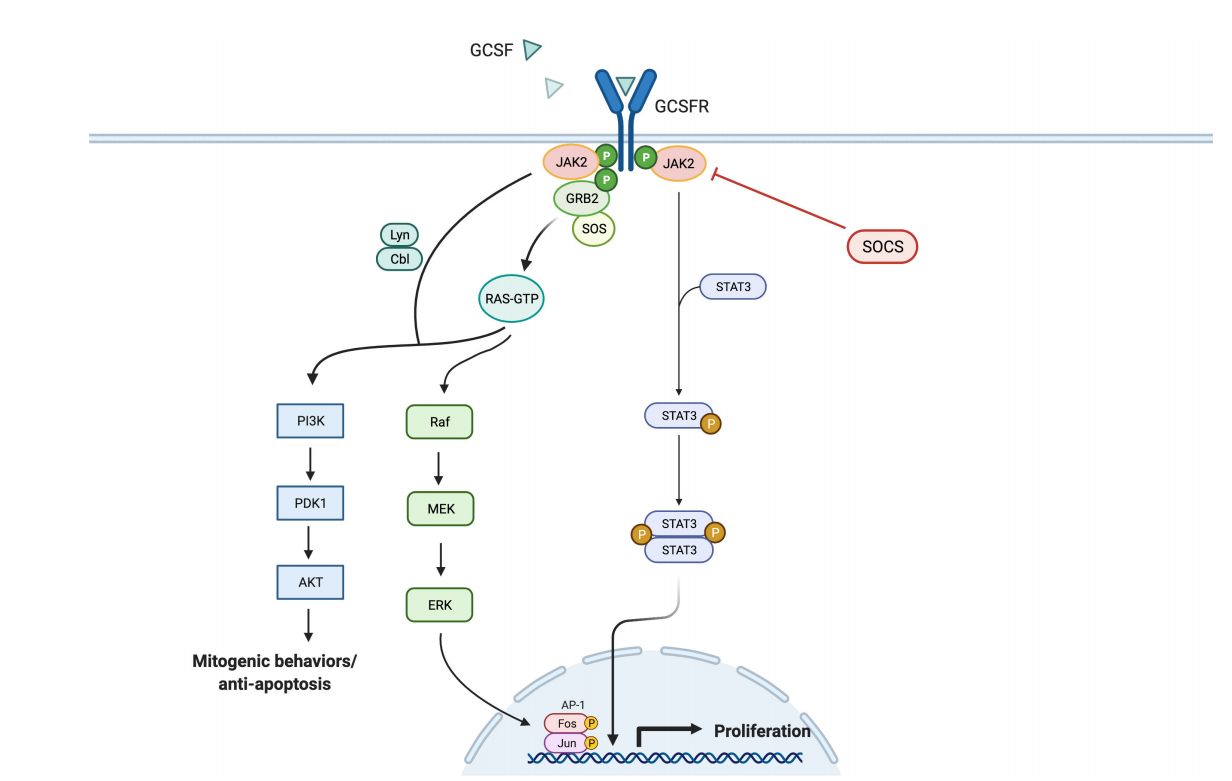
(Data source: Park SD, et al. Front Oncol. 2022)
CSF3R and disease
In cancer, CSF3R primarily promotes tumor cell proliferation, migration, and invasion by activating downstream signaling pathways, while also influencing the tumor microenvironment, creating favorable conditions for tumor growth and metastasis . CSF3R is aberrantly expressed in various cancers, including breast cancer, bladder cancer, glioma, and neuroblastoma. This aberrant expression is often associated with tumor malignancy and poor prognosis. In triple-negative breast cancer (TNBC), CAFs (cancer-associated fibroblasts) secrete CSF3 under hypoxic conditions, activating CSF3R in TNBC cells. This leads to PGM2L1-dependent glycolytic reprogramming, enhancing the malignant phenotype of tumor cells. Specifically, this manifests as significantly enhanced proliferation, migration, and invasion of TNBC cells. Targeting CSF3R and its downstream pathways (such as PGM2L1) holds promise as a new strategy for treating diseases such as TNBC and AML.

(Data source: Qin W, Chen B, Li X, et al. Cell Death Dis. 2025)
CSF3R-targeted therapy
Benegrastim (Ryzneuta) is a fusion protein targeting CSF-3R (GCSFR) developed by Nutrilite can long medical technology (Shanghai) co., LTD. for the treatment of neutropenia, fever, breast cancer, Parkinson's disease, and other diseases. It was approved for marketing in China on May 6, 2023, for the prevention and treatment of neutropenia in cancer patients following chemotherapy. Ryzneuta is a recombinant fusion protein containing human G-CSF and the crystallizable fragment (Fc) domain of human immunoglobulin G2 (IgG2). Ryzneuta exists as a homodimer with an immunoglobulin-like structure, with one G-CSF molecule at each amino (N) terminus.
Anumigilimab, a monoclonal antibody targeting CSF3R , is being developed by CSL and is currently in Phase 2 clinical trials for the treatment of hidradenitis suppurativa, community-acquired pneumonia, and inflammatory conditions. No relevant development progress has been identified.