LINGO1 belongs to the Nogo receptor complex and influences oligodendrocyte differentiation, axonal regeneration, and neuronal survival, playing a crucial role in central nervous system repair. As a negative regulator of neuronal growth, myelination (myelin production), and regeneration, its inhibition has become a promising therapeutic target for neurological diseases such as multiple sclerosis (MS), Parkinson's disease, and traumatic brain injury.

(Data source: Avik A, et al. 3 Biotech. 2023)
LINGO1 Basic Information
LINGO1 is a single-channel type I transmembrane protein composed of 614 amino acids. It contains a 34-residue signal peptide sequence, followed by an LRR (leucine-rich repeat) domain, an Ig (immunoglobulin-like) domain, a stalk domain, a transmembrane region, and a short cytoplasmic tail. Belonging to the leucine-rich repeat protein family, it is a functional component of the Nogo (neuronal growth inhibitor) receptor, also known as the reticulin 4 receptor. It is specifically expressed by oligodendrocytes and neurons in the central nervous system (CNS).
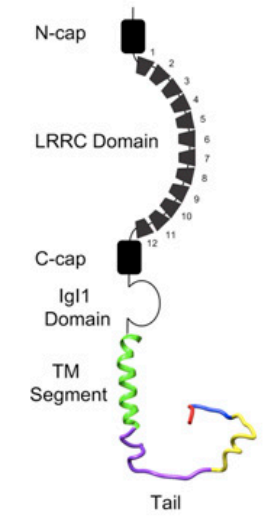
(Data source: Srikanth D, et al. Proc Natl Acad Sci USA. 2020)
LINGO1 signal modulation
LINGO-1 is an essential negative regulator of myelination. It inhibits axonal regeneration through a ternary complex formed with NgR1/Nogo-66 (ligand-binding subunit) and p75 (signal transduction subunit). NgR1 relies on its co-receptor for transmembrane signal transduction. The three main myelin-related inhibitors are Nogo, oligodendrocyte myelin glycoprotein, and myelin-associated glycoprotein, all of which share this three-molecule receptor complex. Inhibition is achieved through the upregulation of RhoA-GTP in the central nervous system in the presence of MOG, MAG, or Nogo-66.
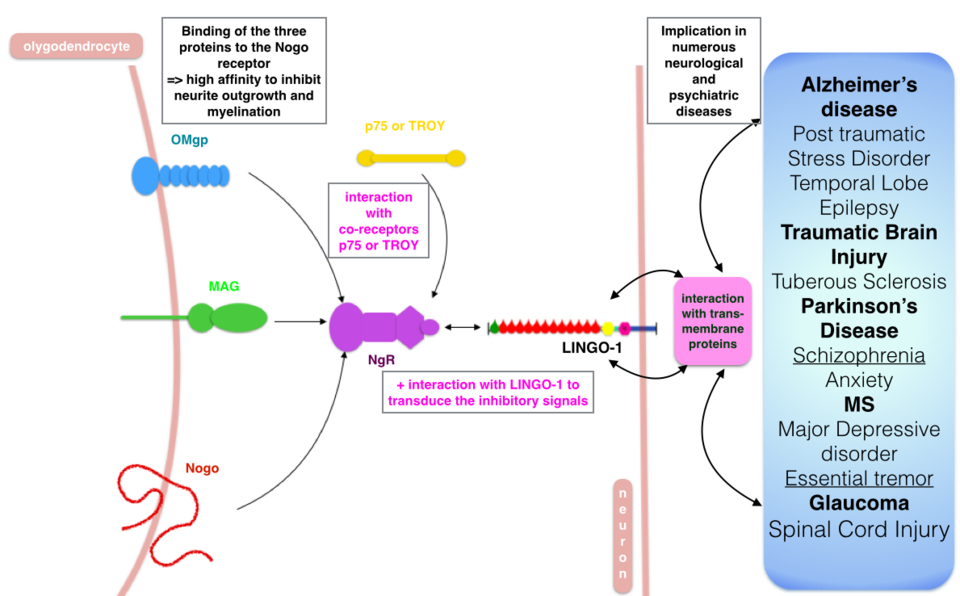
(Data source: Wikipedia)
LINGO1-related diseases
LINGO1 expression regulates the timing of CNS myelination, and upregulation of LINGO1 during neural development indicates the detrimental effects of endogenous proteins. Blocking LINGO1 function leads to significant remyelination in chemically and immunologically induced demyelinating animal models. Remyelination is promoted by blocking or eliminating LINGO1 function in experimental autoimmune encephalomyelitis (EAE) using LINGO1-deficient mice or anti-LINGO1 neutralizing antibodies. In a mouse toxin-induced Parkinson's disease model, LINGO1 knockout mice showed increased dopamine neuron survival and reduced behavioral abnormalities. In a glaucoma disease model, LINGO1 antagonism promoted retinal ganglion cell (RGC) survival.

(Data source: Jessica LA, et al. Neurosci Biobehav Rev. 2015)
LINGO1 antibody drug treatment
The anti-LINGO1 Li81 monoclonal antibody (opicinumab) (dissociation constant KD=20 pM) is a humanized antibody discovered using Fab phage display technology, employing an engineered deglycosylated framework of human IgG1 with reduced effector function. Opicinumab (BIIB033) is designed to treat multiple sclerosis, acute optic neuritis (AON), and other related demyelinating diseases. As a biologic, Phase II clinical trial results showed that the primary endpoint was not met, and opicinumab exhibited an unexpected dose-response. Biogen plans to conduct further studies because opicinumab still shows potential in the clinical efficacy of multiple sclerosis treatment.

(Data source: Mehrdad G, et al. Inflamm Res. 2019)