Interleukin IL11 is a member of the IL-6 cytokine family. IL11 is involved in hematopoiesis and works synergistically with other cytokines to promote bone marrow hematopoiesis, megakaryocyte maturation, and platelet formation. IL11 has pro-inflammatory and pro-fibrotic effects, and recent studies have shown that IL11 also plays a significant role in anti-aging.
Origin of IL11
IL11 is secreted by a variety of mesenchymal cells, including osteoblasts, osteoclasts, chondrocytes, fibroblasts, leukocytes, epithelial cells, keratinocytes, and synoviocytes.

(Data source: Maroni P, et al. Biomedicines. 2021)
Structure of IL11
IL11 is a non-glycosylated, secreted protein composed of 199 amino acids with a molecular weight of approximately 19 kDa. Its gene is located at locus 19q13 on the long arm of human chromosomes. IL11 has a type 1 four-alpha-helical bundle structure. It binds to a receptor complex consisting of a ligand-specific receptor subunit (IL11 Rα or the soluble form sIL11 Rα) and the transmembrane glycoprotein β subunit gp130. It coordinates hexameric assembly with the two copies of IL11 , IL11 Rα, and gp130 through interactions at three primary binding sites.

(Data source: Gardner S, Jin Y, Fyfe PK, et al. Nat Commun. 2024)
IL11 signaling pathway and regulation:
IL11 can only induce GP130 signaling when it forms a complex with IL11Rα and GP130. The formation of the IL11/sIL11R complex allows two GP130 molecules to dimerize, initiating intracellular signaling by activating the JAK/STAT, MEK/ERK1/2, and PI3K/Akt/mTOR signaling pathways. Suppressor of cytokine signaling 3 (SOCS3) , Src homology 2 domain-containing tyrosine phosphatase (SHP2) , and protein inhibitor of activated STAT3 ( PIAS3 ) are inhibitors of IL11 signaling.

(Data source: Kortekaas RK, et al. Trends Pharmacol Sci. 2021)
IL11 and Diseases:
IL11 plays an important role in many diseases, including pulmonary fibrosis, asthma, solid tumors and other diseases. Studies have found that IL11 is related to aging.
IL11 and idiopathic pulmonary fibrosis (IPF): Interleukin (IL)-11 may contribute to the pathophysiology of idiopathic pulmonary fibrosis (IPF) by inducing the formation of profibrotic myofibroblasts and impairing the regeneration of the alveolar epithelium.

(Data source: Kortekaas RK, et al. Trends Pharmacol Sci. 2021)
IL11 and Asthma: IL11 is an immunoregulatory cytokine that inhibits Th1 polarization, promotes Th2 polarization, and stimulates the production of Th2 cytokines such as IL-4 and IL-10. Asthma is often associated with this Th2 response. Th2 responses are associated with airway hyperresponsiveness, inflammation, airway remodeling, mucus hypersecretion, and bronchoconstriction, which are all hallmarks of asthma.
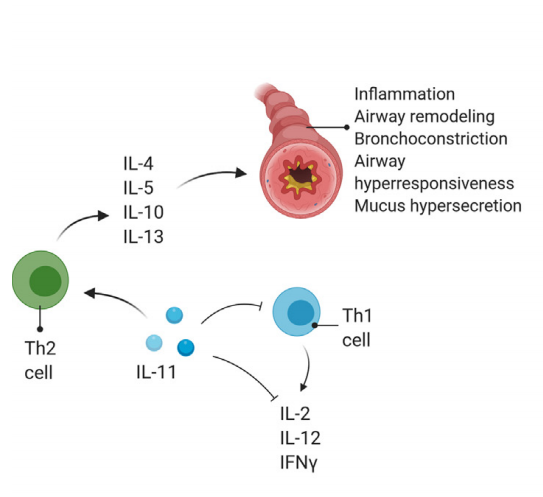
(Data source: Kortekaas RK, et al. Trends Pharmacol Sci. 2021)
IL11 and solid tumors: In lung cancer, cancer-associated fibroblasts (CAFs) may secrete IL11, which may activate phosphatidylinositol 3-kinase (PI3K)/Akt and/or signal transducer and activator of transcription 3 (STAT3) signaling in lung cancer cells. Studies have found that lung cancer cells can induce autocrine IL11 signaling, which is thought to stimulate lung cancer cell proliferation and survival. IL11 is also involved in lung cancer migration, invasion, and metastasis. Finally, STAT3 activation stimulates the release of vascular endothelial growth factor (VEGF), leading to increased angiogenesis. These processes can promote tumor formation.

(Data source: Kortekaas RK, et al. Trends Pharmacol Sci. 2021)
IL11 and Aging: Recent studies have identified the proinflammatory cytokine IL11 as a key factor influencing healthspan and lifespan in mammals. IL11 is upregulated across cell types and tissues, thereby regulating the ERK-AMPK-mTORC1 axis and, in turn, modulating aging pathologies at the cellular, tissue, and organismal levels. Deletion of IL11 or IL11Rα protects against metabolic decline, multiple diseases, and frailty in old age. IL11 levels gradually increase with age. Knocking out the gene encoding IL11 or inhibiting IL11 activity can extend the median lifespan of mice by 25%. This suggests that inhibiting IL11 can slow aging and represents a potential new anti-aging target. Anti-IL11 therapies in early clinical trials for fibrotic lung diseases may provide translational opportunities to determine the impact of IL11 inhibition on aging pathologies in the elderly.
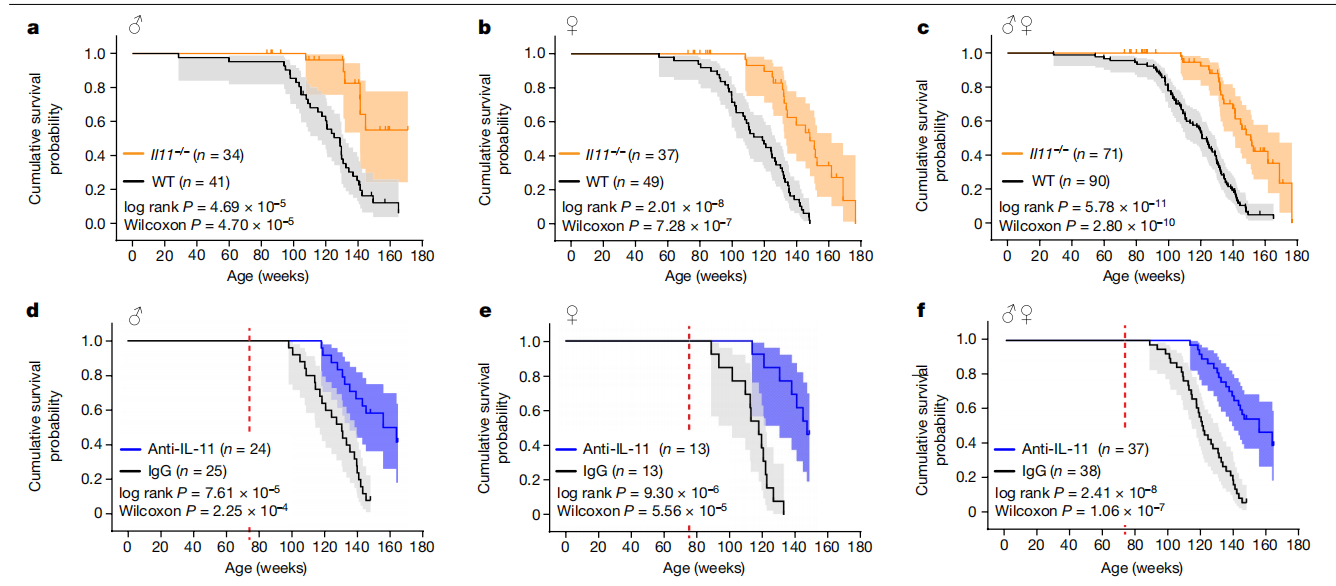
(Data source: Widjaja AA, et al. Nature. 2024)