Receptor tyrosine kinase-like orphan receptor 1 (ROR1) is lowly expressed or absent in normal tissues, but its expression is significantly elevated in a variety of malignancies and diseases, including chronic lymphocytic leukemia (CLL), breast cancer, ovarian cancer, melanoma, and lung adenocarcinoma. ROR1 is an attractive target for tumor-specific therapies. Currently, multiple ROR1-targeted drugs are in clinical development, including monoclonal antibodies, antibody-drug conjugates (ADCs), and chimeric antigen receptor T cell therapy (CAR-T). In addition, four small molecule inhibitors that bind to ROR1 offer a promising avenue for the development of PROTAC-based degraders targeting ROR1.
On August 12, 2024, researchers from the National Key Laboratory of Small Molecule Regulation of Life Processes, Shanghai Institute of Organic Chemistry, Chinese Academy of Sciences, published an article titled "Unlocking the potential: advancements and future horizons in ROR1-targeted cancer therapies" in Science China. Life sciences. The article reviewed the research progress on the structural and functional characteristics, embryonic development significance, cell survival signaling pathways, and evolutionary targeting strategies of ROR1, providing new ideas for the treatment of malignant tumors.
Composition and structure of ROR1
The receptor tyrosine kinase-like orphan receptor ( ROR ) family constitutes a subfamily of receptor tyrosine kinases (RTKs) characterized by a conserved and unique kinase domain. This family includes two members, ROR1 and ROR2, which share 58% amino acid identity. ROR1 has four isoforms: the intact cell membrane receptor (105 kD), the glycosylated intact cell membrane receptor (130 kD), the intact cell membrane receptor dimer (260 kD), and a truncated form (64 kD). The truncated form is primarily distributed in the nucleus, with low expression levels that are not associated with tumor development or severity. The intact ROR1 exhibits high specificity in various tumor tissues.

The ROR1 gene is 2812 bp long and located on chromosome 1p31.3. It is a type I transmembrane receptor tyrosine kinase protein composed of 937 amino acids. Its extracellular domain is composed of an immunoglobulin-like domain ( Ig ), a coiled-coil domain ( FZD ), and a membrane-proximal KRD domain. The FZD domain participates in the Wnt signaling pathway, while the KRD domain facilitates Wnt recognition and macromolecular binding. The intracellular domain comprises a tyrosine kinase domain ( TKD ), two serine/threonine-rich domains ( S/TRDs ), and a proline-rich domain (PRD).

ROR1 signaling pathway and regulation:
ROR1, as a receptor for Wnt5a, participates in the activation of the NF-κB pathway. Wnt5a/ROR1 is highly expressed in various tumors and plays an important role in promoting cell migration, invasion, epithelial-mesenchymal transition (EMT), and tumor metastasis.

ROR1 is highly expressed in various cancers
Human Proteome Map analysis revealed that ROR1 is overexpressed in fetal tissues, particularly in the fetal heart. In contrast, ROR1 expression in adults is significantly reduced or almost absent. ROR2 is present throughout human development and remains overexpressed in adult tissues and organs.
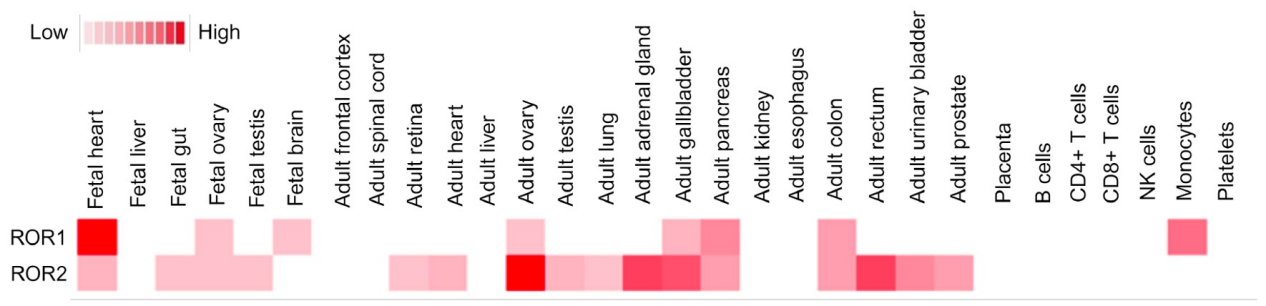
Human protein profiling data show that ROR1 is expressed in most cancers, including chronic lymphocytic leukemia (CLL), breast cancer, ovarian cancer, lung cancer, pancreatic cancer, colorectal cancer, melanoma, etc.

Progress in the development of drugs targeting ROR1
Currently developed antibody-based immunotherapies targeting ROR1 include ROR1 monoclonal antibodies, bispecific monoclonal antibodies, polyclonal antibodies, ADCs, and CAR-T cells.
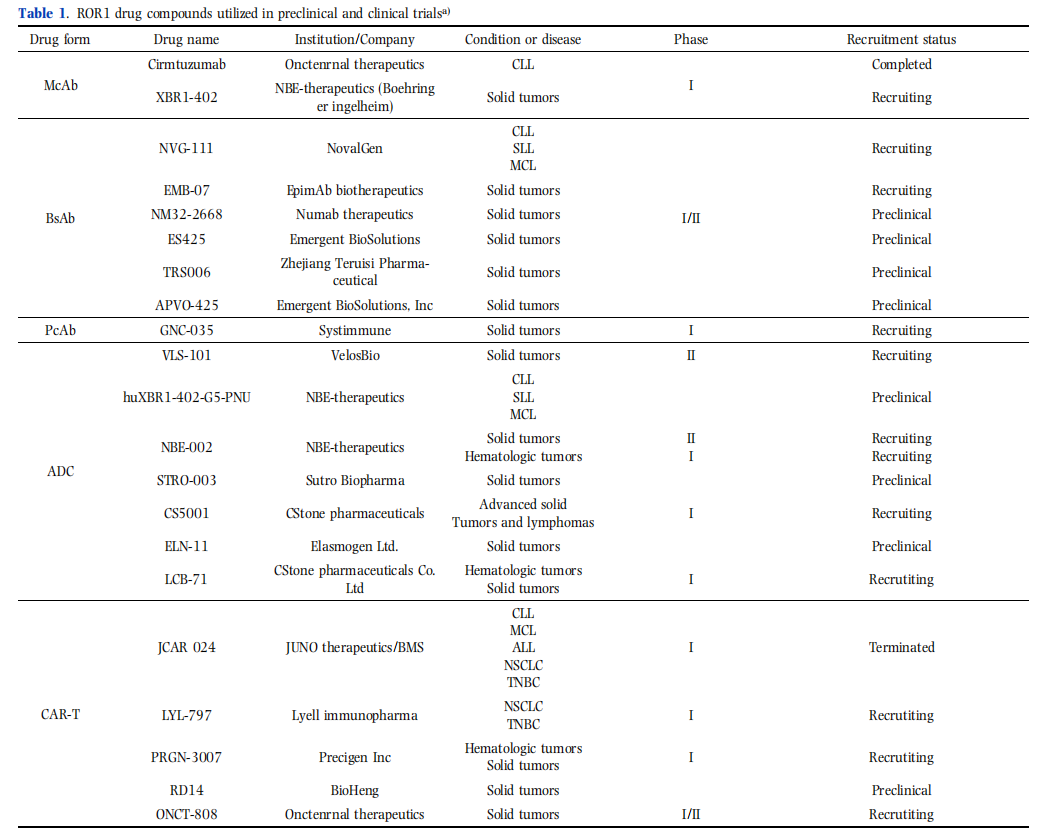
ROR1-targeted monoclonal antibodies: Zilovertamab is a humanized monoclonal antibody with a unique epitope that blocks the Wnt5A signaling pathway by binding to ROR1. Zilovertamab prevents the phosphorylation and nuclear translocation of the key transcription factor p65, thereby promoting tumor cell differentiation and inhibiting their uncontrolled growth, motility, and survival; in addition, it can inhibit the release of proinflammatory cytokines such as IL-6. Zilovertamab is currently in Phase III clinical development, combining the monoclonal antibody with ibrutinib for the treatment of mantle cell lymphoma (MCL) and CLL. An ongoing Phase 1b clinical trial is investigating the combination of zilovertamab and paclitaxel for the treatment of HER2-negative metastatic or unresectable locally advanced breast cancer. A Phase 2 clinical trial of zilovertamab combined with the Bcl-2 inhibitor venetoclax for the treatment of relapsed/refractory CLL is underway.

Bispecific Antibodies: NVG-111 is a novel ROR1×CD3 bispecific antibody that effectively enhances T cell targeting of ROR1+ tumors. NVG-111 strategically connects T cells with tumor antigens, helping to guide endogenous T cells directly to tumor sites. Upon antigen binding, NVG-111 promotes the formation of immune synapses, triggering a cascade leading to the release of perforin, granzyme B, and cytokines. This process is independent of major histocompatibility complex (MHC), costimulatory molecules, and antigen presentation mechanisms, providing a versatile approach for cancer immunotherapy.

ROR1-targeted ADC therapy: VLS-101 (Zilovertamab vedotin) is a novel therapeutic ADC targeting ROR1 developed by VelosBio. It maintains the high-affinity binding properties of the Zilovertamab antibody and allows ROR1 to proteolytically cleave the mc-vc-PAB linker and release the cytotoxic drug MMAE into cells.
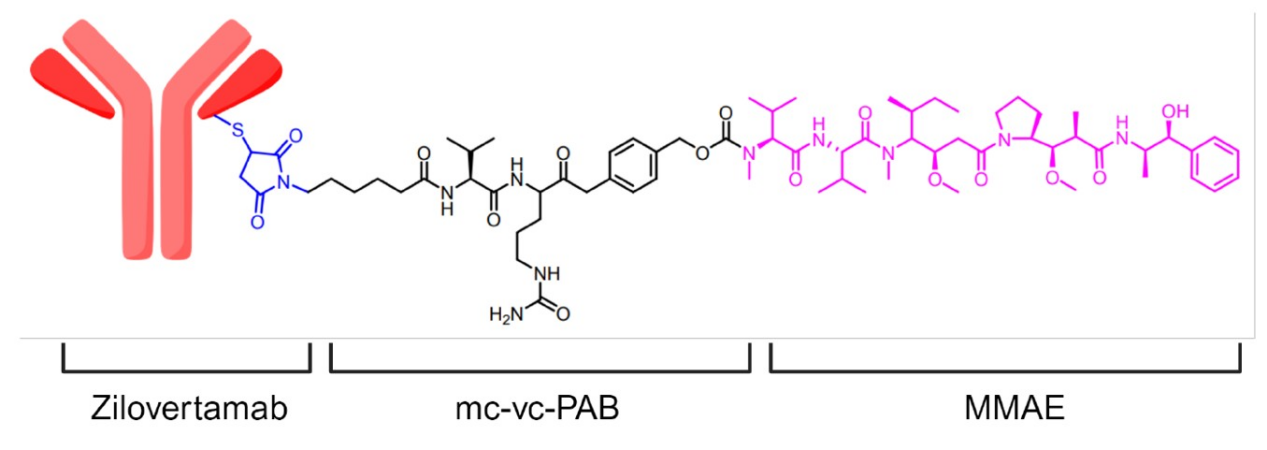
VSL-101 binds to ROR1 on the surface of tumor cells and is internalized into endosomes. Endosomes fuse with lysosomes, where the linker between the antibody and MMAE is cleaved, releasing MMAE into the cytoplasm. MMAE inhibits microtubule function, essential for cell division and survival, and induces tumor cell death. A Phase 2/3 clinical trial is currently underway to investigate the potential of VSL-101 in treating various hematologic malignancies and solid tumors.

CAR-T therapy targeting ROR1: ROR1 is specifically expressed in tumor cells and is a target antigen for CAR-T cell therapy. PRGN-3007 is another CAR-T cell therapy developed based on Precigen's UltraCAR-T platform for the treatment of various hematologic and solid tumor malignancies. PRGN-3007 is currently in a Phase 1/1b dose-escalation and expansion study to evaluate its safety and efficacy in patients with advanced ROR1-positive hematologic and solid tumor malignancies, such as triple-negative breast cancer.

Small molecule inhibitors and peptides: Studies have found that small molecule inhibitors can more easily penetrate cell membranes and target proteins and signaling pathways within cells, while antibody drugs mainly target proteins on the cell surface or body fluids, which can affect the therapeutic effect on tumor cells with relatively low ROR1 expression. Currently, there are five types of small molecules that can bind to ROR1.

Potential PROTAC development: Using PROTAC is another new therapeutic strategy for ROR1 degradation. It is a method to recruit E3 ubiquitin ligases on target proteins to degrade specific proteins.