OX40 is a T cell co-stimulatory molecule and a member of the tumor necrosis factor receptor superfamily member 4 (TNFRSF4), also known as CD134. OX40 plays a crucial co-stimulatory role in T cell activation, mediating the survival and expansion of CD4+ and CD8+ T cells in various animal models of autoimmunity, infectious diseases, and cancer. OX40 also participates in the control of effector and memory T cell responses. OX40 and its cognate ligand, OX40L, are potential therapeutic targets for T cell-mediated diseases, including autoimmune diseases and cancer.

(Data source: Fu Y, et al. Acta Pharm Sin B. 2020)
OX40 expression distribution
OX40 is not expressed on naive T cells but is expressed as a secondary co-stimulatory immune checkpoint molecule 24 to 72 hours after activation. It is expressed on activated CD4+ and CD8+ T cells, neutrophils, and natural killer (NK) cells. OX40 is constitutively expressed in mouse FOXP3+ Treg cells.
OX40L is primarily expressed on activated antigen-presenting cells (APCs), such as dendritic cells (DCs), activated B cells, and macrophages. OX40L is also expressed on hematopoietic cells, such as activated NK cells, mast cells, or responding CD4+ T cells, as well as non-hematopoietic cells, such as endothelial cells or smooth muscle cells.

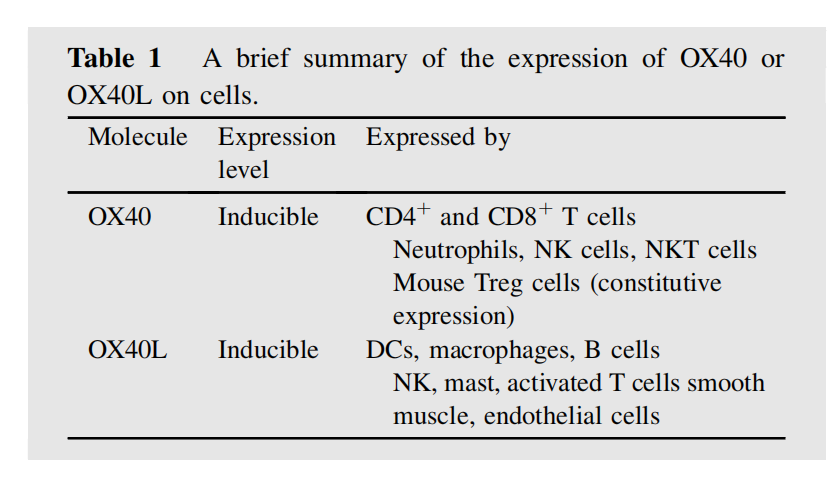
(Data source: Fu Y, et al. Acta Pharm Sin B. 2020)
Structure of OX40 and its ligand
OX40 is a type I transmembrane glycoprotein composed of approximately 275 amino acids with an apparent molecular weight of 50 kDa and three complete cysteine-rich domains (CRDs) and a partial C-terminal CRD.
The ligand of OX40 (OX40L, also known as CD252) is also a member of the TNFR superfamily. OX40L is a type II glycoprotein with a 23-amino acid cytoplasmic tail and a 133-amino acid extracellular domain.
OX40L binds to three molecules of OX40 protein in the form of a trimer to form a hexameric complex and activate downstream signal transduction.

(Data source: Willoughby J, et al. Mol Immunol. 2017)
OX40 signaling pathway and regulation:
Both OX40 and OX40L signal through the TNF receptor-associated factor (TRAF) adaptor molecule. OX40-OX40L initiates a signaling cascade by activating the phosphoinositide 3-kinase ( PI3K ) pathway, leading to downstream phosphorylation and subsequent activation of protein kinase B ( PKB, also known as Akt ) . The PI3K-PKB/Akt pathway helps regulate cell growth, survival, and metabolism. By controlling PI3K-PKB/Akt activation in T cells, the OX40-OX40L pathway plays an integral role in promoting T cell proliferation, differentiation, and survival.
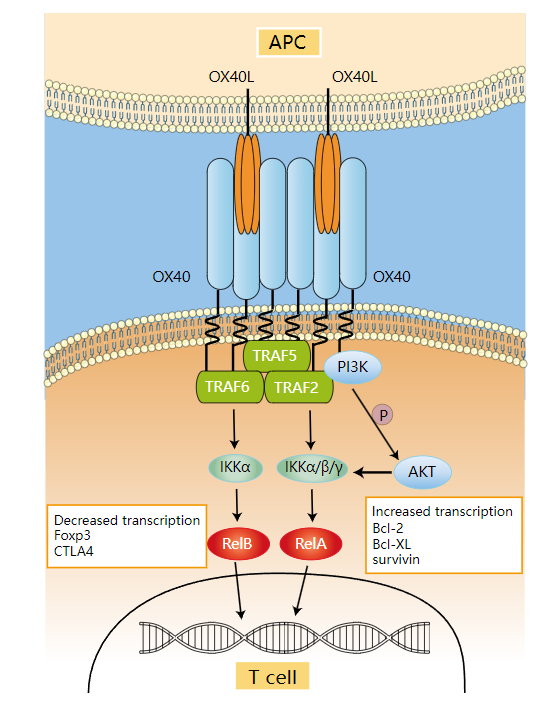
(Data source: Creative Diagnostics official website)
Effects of the interaction between OX40 and OX40L on T cells
In CD4+ T cell subsets, OX40-OX40L signaling can enhance Th1 -mediated immune responses through the non-canonical NF-κB pathway , promote the generation and maintenance of Th2, promote the differentiation of Th9, promote the development of Tfh, and antagonize the generation of Treg and Treg-mediated suppression. In CD8+ cytotoxic T cells, the participation of OX40 was found to be crucial for the survival and expansion of primed CD8+ T cells and their response to antigen stimulation.

(Data source: Fu Y, et al. Acta Pharm Sin B. 2020)
OX40-targeted disease treatment
Treatment of autoimmune diseases
OX40/OX40L blockade improves autoantigen-specific T cell responses and reduces immune activity in autoimmune diseases. Therefore, blocking the OX40/OX40L pathway is of great significance for the treatment of autoimmune diseases such as EAE, SLE, RA, colitis, AEU, type 1 diabetes, MS, graft-versus-host disease (GVHD), and inflammatory bowel disease (IBD).
OX40L promotes inflammation by activating the OX40 signaling pathway, promoting the activation of helper T cells such as Th2 cells and upregulating the production of proinflammatory cytokines. OX40/OX40L is a promising therapeutic target for atopic dermatitis (AD). Currently used drugs for the treatment of atopic dermatitis include rocatinlimab, telazorlimab, and amiritelimab.
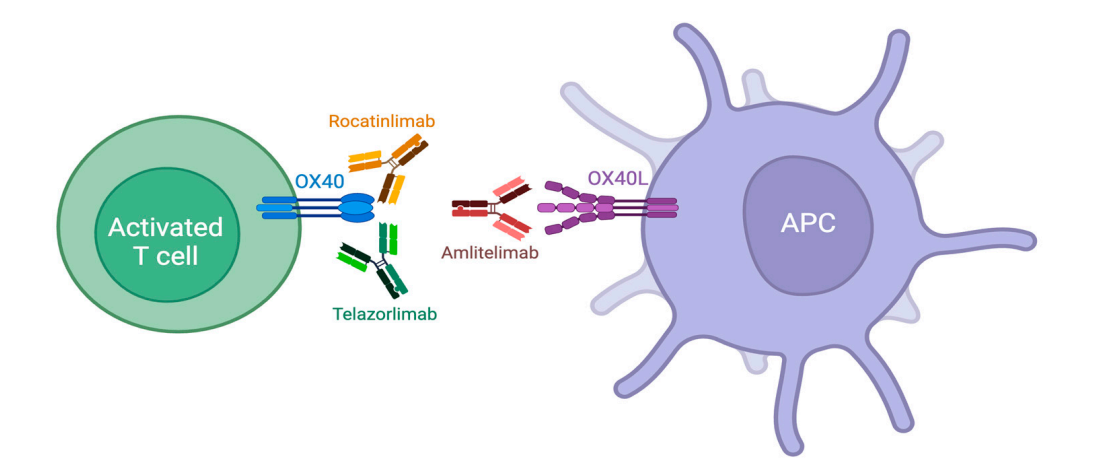
(Data source: Sadrolashrafi K, et al. Cells. 2024)
Rocatinlimab is a fully human anti-OX40 monoclonal antibody that selectively depletes OX40-activated T cells and downregulates Th1-, Th2-, Th17-, and Th22-mediated inflammation. The Phase III HORIZON study (NCT05651711) found positive results with rocatinlimab monotherapy in adults with moderate to severe AD. After 24 weeks, 32.8% of patients achieved a reduction of at least 75% in the Eczema Area and Severity Index (EASI-75), compared to 13.7% of patients taking placebo. The rIGA 0/1 response rate was 16.4% in the treatment group and 4.9% in the placebo group. Overall safety results were similar to those in the Phase 2b trial.
Amlitelimab is a fully human anti-OX40L monoclonal antibody that binds to OX40L. Amlitelimab binds to OX40L and blocks its interaction with OX40, thereby inhibiting T cell-mediated inflammatory activation. Amlitelimab also reduces the pro-inflammatory activity of APCs by blocking the OX40L reverse signaling pathway . Amlitelimab is currently in a placebo-controlled, double-blind Phase 3 trial in adults with moderate to severe AD (NCT06181435, NCT06130566). Sanofi's public information indicates that amlitelimab has the potential to require only a single treatment every 12 weeks (3 months), significantly reducing the treatment burden on patients.
Telazorlimab is a humanized anti -OX40 monoclonal antibody that selectively depletes activated T cells, thereby interrupting the inflammatory pathway associated with AD. Currently in its final phase, telazorlimab is less effective than rocatinlimab. Due to its high incidence of adverse events, including AD, nasopharyngitis, upper respiratory tract infections, headache, pruritus, and fatigue, studies on this antibody drug have been terminated.

Cancer treatment
OX40-XO40L signaling promotes the survival of conventional (non-regulatory) CD4+ and CD8+ T cells, maintains the expression of anti-apoptotic proteins such as BCL-XL, BCL-2, and survivin, enhances the production of cytokines such as IL-2, IL-4, IL-5, and IFN-γ, strengthens effector tumor-specific T cell immune responses, and increases the generation of tumor-specific memory T cells after antigen challenge. OX40 agonists may enhance anti-tumor immunity against immunogenic tumors. Numerous cancer therapeutics targeting OX40 and OX40L are currently in clinical trials.

(Data source: Fu Y, et al. Acta Pharm Sin B. 2020)

(Data source: Sadrolashrafi K, et al. Cells. 2024)