CXCR4, also known as CD184, is a CXC chemokine receptor type 4, a class A G protein-coupled receptor (GPCR). It is activated by chemotactic ligands and participates in regulating hematopoiesis, angiogenesis, vasculogenesis, and cell migration in various other physiological processes. CXCR4 is implicated in various diseases, including its involvement as a cancer marker in tumor proliferation.
CXCR4 expression distribution
CXCR4 is mainly expressed in immune cells, such as T cells, B cells, NK cells, monocytes, dendritic cells, and Langerhans cells, and is also expressed in small amounts in neurons.

(Data source: Uniprot)
Structure of CXCR4 and its ligands
CXCR4 is a multi-transmembrane protein composed of 352 amino acids, comprising seven transmembrane helices, three extracellular loops, three intracellular loops, and an intracellular-terminal region. CXCR4 can exist in the plasma membrane as monomers, dimers, higher-order oligomers, or nanoclusters. Its inactive state often exists as a homodimer, and crystal structures reveal that interactions between transmembrane helices (such as TM5 and TM6) mediate dimerization.
The canonical ligand for CXCR4 is CXCL12, also known as stromal cell-derived factor 1 (SDF-1). The chemokine CXCL12 inserts its N-terminus (residues 1-12) into the orthosteric pocket of CXCR4, forming hydrogen bonds and hydrophobic interactions with specific residues in the TM core (e.g., Y116, D97, and E288). This induces an outward shift of TM6, triggering conformational changes in the receptor and activating downstream G protein (Gαi) signaling. In the activated state, TM6 of CXCR4 bends outward, and the intracellular loop (ICL3) and helix 8 (H8) become more ordered, promoting G protein binding.


(Data source: Saotome K, McGoldrick LL, Ho JH, et al. Nat Struct Mol Biol. 2024)
CXCR4 signaling pathway and regulation:
Activation of CXCR4 can promote multiple signal transduction pathways. CXCR4 belongs to the GPCR family, activating G proteins, which in turn trigger the ERK MAPK, PLC, and PI3K-PKB/Akt pathways. Furthermore, CXCR4 can activate certain pathways independently of G proteins, such as the Wnt-β-catenin and STAT pathways. CXCR4 promotes AML cell proliferation by activating the Wnt-β-catenin pathway. Furthermore, AML cell proliferation may also be affected by the ERK MAPK and PI3K-PKB/Akt pathways. CXCR4 also induces drug resistance by inhibiting apoptosis, a mechanism that may involve increased expression of Bcl-2 and Bcl-xL via the PI3K/PKB/Akt and YY1 pathways. Another mechanism by which CXCR4 induces chemoresistance is enhanced autophagic activity.
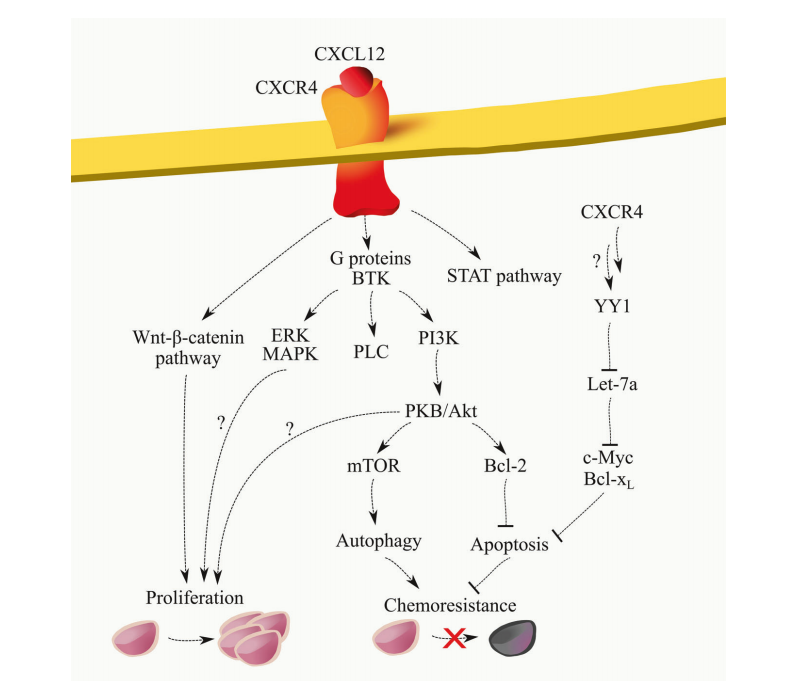
(Data source: Korbecki J, et al. Leukemia. 2024)
CXCR4-targeted therapy
The CXCL12-CXCR4 axis is crucial in the pathogenesis of AML, including promoting autonomous proliferation of leukemic cells, regulating apoptosis, chemoresistance, and interactions with other cells in the bone marrow microenvironment, such as mesenchymal stem cells and regulatory T cells. Multiple therapies targeting CXCR4 exist, including chemical antagonists, monoclonal antibodies, and BTK inhibitors.
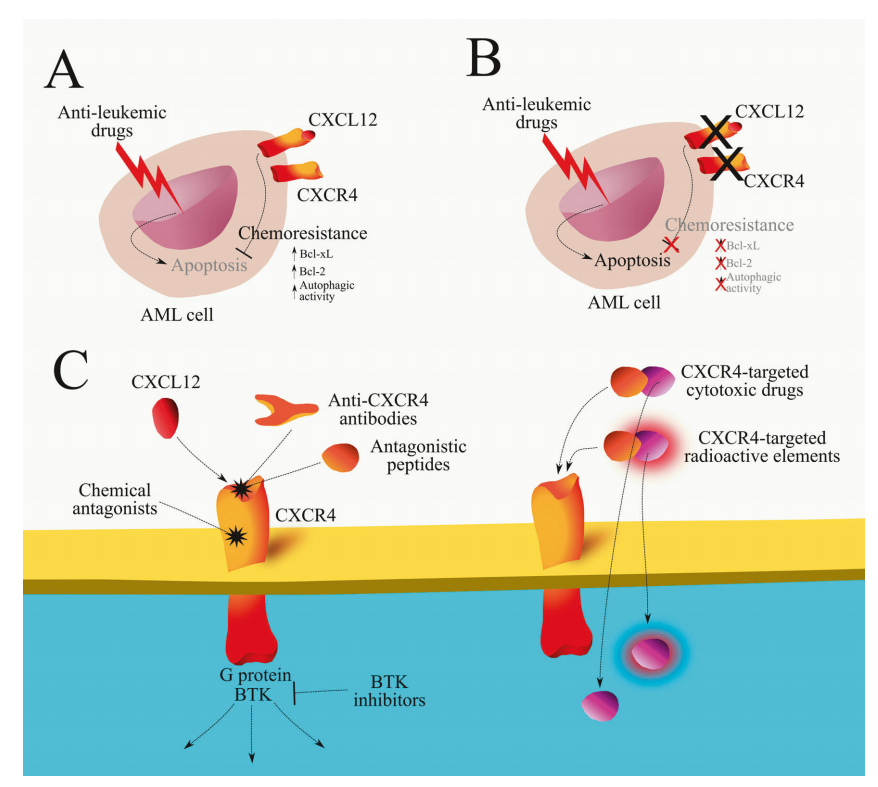
CXCR4 antagonists: AMD3100 (plerixafor) is a chemoantagonist that binds to CXCR4, thereby preventing its activation by CXCL12. Clinical studies have found that its combination with chemotherapy can improve remission rates. However, AMD3100 is not an effective monotherapy. In monotherapy, this compound can reduce the proliferation of AML cells but does not induce AML cell death. Therefore, as a monotherapy, it may only inhibit the development of AML but not cure it. Clinical studies have shown that when used in combination with standard drugs, this compound only induces disease remission in a subset of patients. Due to its poor efficacy, it may not be included in standard treatment options for AML.
CXCR4 Monoclonal Antibodies: Ulocuplumab (BMS-936564) is a human IgG4 monoclonal antibody targeting CXCR4, developed by Bristol Myers Squibb. It blocks CXCL12 from binding to its receptor and activating CXCR4. In in vitro studies, ulocplumab reduced the proliferation of AML cells. In an in vivo study using mouse xenograft models of AML and MM, uloplumab monotherapy showed therapeutic activity. An ongoing clinical trial is investigating uloplumab in combination with low-dose cytarabine in patients with AML (Clinicaltrials.gov ID: NCT02305563), but the results are not yet published.
PF-06747143 is another CXCR4-targeting antibody. It is an IgG1 monoclonal antibody with CXCR4 antagonist properties. PF-06747143 binds to this receptor, preventing CXCR4 activation by CXCL12. It directly kills CXCR4-overexpressing AML cells through antibody-dependent cellular cytotoxicity (ADCC), significantly reducing leukemia burden in animal models.
BTK Inhibitor: Ibrutinib is a compound inhibitor targeting the CXCR4 signaling pathway. It is a BTK inhibitor, which is essential for CXCR4 signaling. BTK is activated by activated G proteins. BTK also plays a crucial role in signaling through receptors such as the B cell receptor (BCR), toll-like receptors (TLRs), and Fc receptors (FcRs). By inhibiting BTK, ibrutinib blocks CXCR4 signaling, thereby inhibiting CXCL12-induced PKB/Akt and MAPK activation.
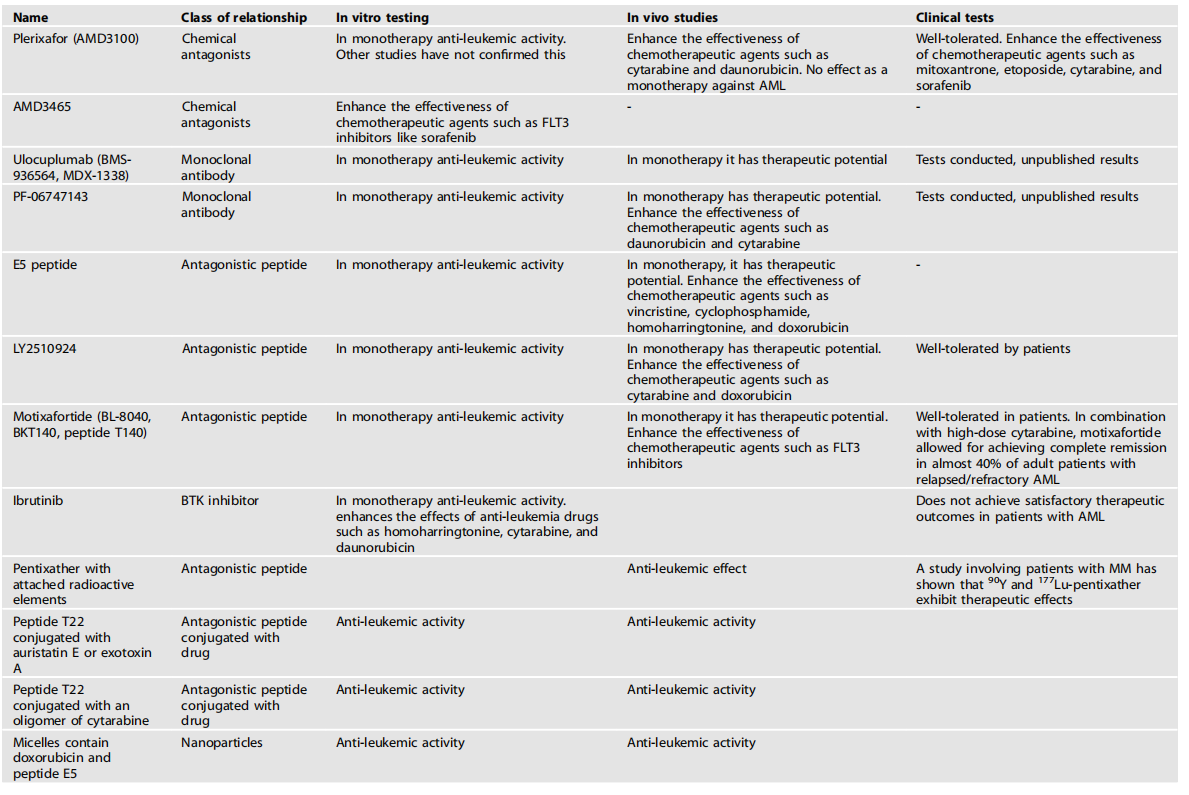
(Data source: Korbecki J, et al. Leukemia. 2024)