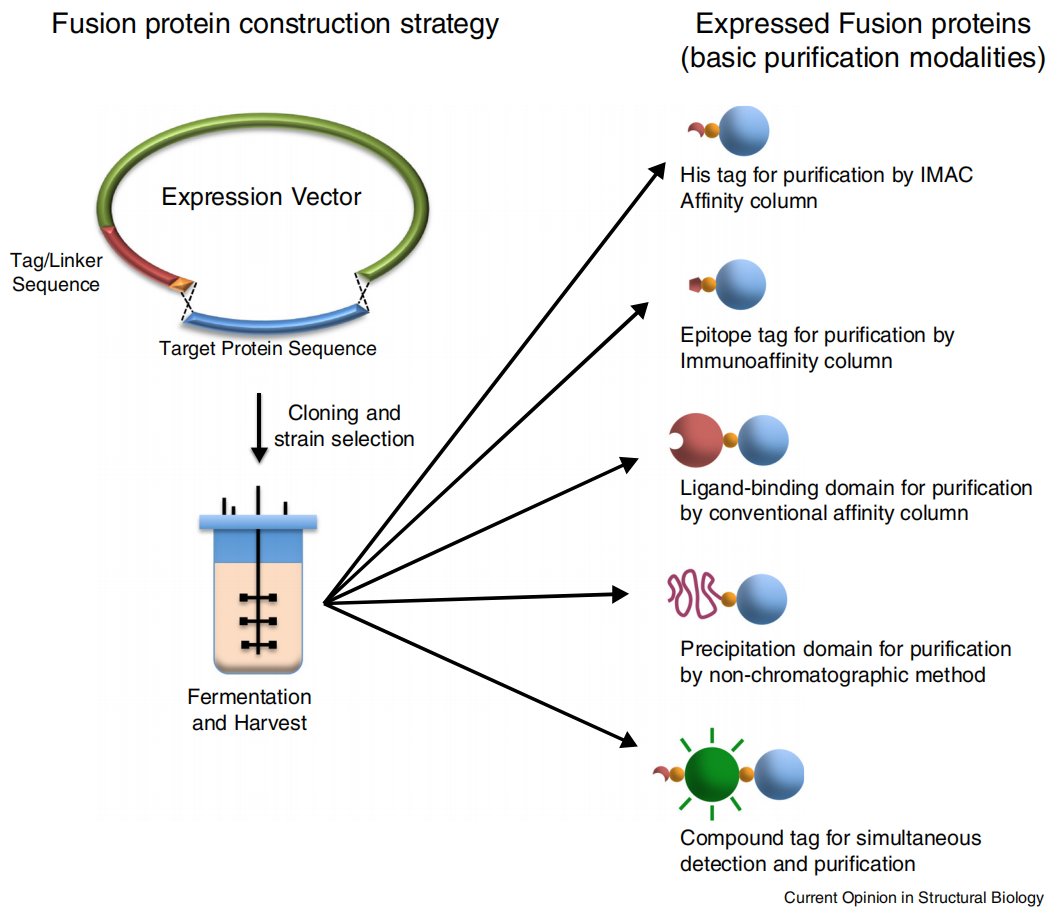
Recombinant proteins are proteins obtained through the use of recombinant gene cloning techniques. Recombinant protein expression technology has been widely used in various fields of biology. Currently, the following main types of in vitro recombinant protein expression systems are available: prokaryotic expression systems (Escherichia coli expression systems, Bacillus subtilis expression systems), eukaryotic expression systems (yeast expression systems, insect cell expression systems, and mammalian cell expression systems). A typical expression experiment involves three steps: vector construction, expression identification, and protein purification. A protein tag is a polypeptide or protein that is fused with the target protein to facilitate its expression, detection, tracing, and purification. With the continuous advancement of technology, researchers have developed protein tags with various functions. This article will provide a systematic introduction to some common protein tags and how to choose one.
Types of protein tags
Common protein tags can be divided into affinity tags, epitope tags, and fluorescent tags based on their application. Affinity tags are generally longer and can be used for purification or to increase protein solubility, such as GST, SUMO, MBP, Fc, etc. Epitope tags are often short peptide sequences and can be used in immunological applications such as Western Blot and immunoprecipitation. Common epitope tags include His, Flag, HA, and C-Myc. Fluorescent tags can be used for live and dead cell detection. The most commonly used fluorescent proteins include green fluorescent protein (GFP).
Common protein tags
I. 6xHis-tag
6xHis is a fusion tag consisting of six histidine residues that can be inserted at the C-terminus or N-terminus of a target protein. 6xHis serves as both an affinity tag and an epitope tag, enabling purification and detection. The side chains of histidine residues strongly attract nickel in solid state, making it suitable for separation and purification of recombinant proteins using immobilized metal chelate chromatography (IMAC).
6xHis tag sequence: HHHHHH
6xHis tag features:
1. The 6xHis tag has a small molecular weight of only ~0.84KD and generally does not affect the function of the target protein;
2. His-tagged fusion proteins can be purified in the presence of nonionic surfactants or under denaturing conditions;
3. His-tagged fusion proteins have also been used in protein-protein and protein-DNA interaction studies;
4. The immunogenicity of the His tag is relatively low, and the purified protein can be directly injected into animals for immunization and antibody preparation;
5. Can be applied to a variety of expression systems, and the purification conditions are mild;
6. It can be used together with other affinity tags to construct dual affinity tags.
II. GST-tag
The GST (glutathione-S-transferase) tag protein itself is a transferase that plays a key role in detoxification. It is a 211-amino acid protein with a molecular weight of 26 kDa. Native GST protects cells from harmful compounds and oxidative stress. GST is primarily used in prokaryotic expression for two main reasons: first, it is a highly soluble protein, which can be used to increase the solubility of exogenous proteins; second, it can be expressed in large quantities in Escherichia coli, thereby increasing expression levels. A key characteristic of GST is its affinity for the tripeptide (glutathione), making it suitable for use in affinity chromatography. When a solution containing GST is passed through a chromatography column lined with immobilized glutathione, GST binds to glutathione, separating it from the rest of the solution.
Advantages and disadvantages of GST label:
1. The GST fusion expression system is widely used to express a variety of fusion proteins in host cells such as E. coli and yeast. GST-tagged proteins can be purified directly from bacterial lysates using a Sepharose affinity resin containing reduced glutathione. GST-tagged proteins can be eluted under mild, non-denaturing conditions, thereby preserving their antigenicity and biological activity. Bound fusion proteins are eluted with 10 mM reduced glutathione under non-denaturing conditions.
2. GST loses its ability to bind to glutathione resin under denaturing conditions, so strong denaturants such as guanidine hydrochloride or urea should not be added to the purification buffer. If the GST fusion part needs to be removed, it can be removed with a site-specific protease.
3. The GST tag can be easily detected using enzymatic assays or immunoassays.
4. GST is a commonly used purification tag that promotes solubility and stability; it helps protect recombinant proteins from degradation by extracellular proteases and improves their stability. In most cases, GST-fusion proteins are fully or partially soluble.
5. The large molecular weight may affect protein function and downstream experiments;
6. If the protein is insoluble, it is difficult to purify it using denaturing methods.
III. SUMO-tag
The SUMO tag protein is a small ubiquitin-like modifier protein composed of 100 amino acids and is a key member of the ubiquitin superfamily of polypeptide chains. While SUMO and ubiquitin share only 18% homology in their primary structure, their tertiary structures and biological functions are very similar.
Advantages and disadvantages of SUMO tagging:
1. The SUMO tag promotes the soluble expression of the target protein and increases the expression level of the fusion protein;
2. The SUMO tag can act as a molecular chaperone to promote correct protein folding;
3. SUMO is resistant to heat and proteases;
4. SUMO proteolytic enzymes can recognize the tertiary structure of the SUMO tag, which can be efficiently removed by the SUMO proteolytic enzyme without any amino acid residues, resulting in a tag-free target protein;
5. SUMO itself does not have an independent purification tag function, so it must be used in combination with other tags such as the His tag;
6. The large molecular weight may affect protein function and downstream experiments.
IV. MBP-tag
The MBP (maltose binding protein) tag protein consists of 370 amino acids with a molecular weight of approximately 40 kDa. It is encoded by the malE gene of Escherichia coli K12. The folding process of MBP requires the assistance of two molecular chaperone systems: DnaK-DnaJ-GrpE and GroEL-GeoES. These molecular chaperones also gather near the target protein, helping it to fold correctly and increase its solubility. Therefore, it is often used as a fusion tag to increase the solubility and expression level of the target protein.
Advantages and disadvantages of MBP tags:
1. MBP tag protein can promote the correct folding of connexins and increase the solubility of fusion proteins overexpressed in bacteria, especially eukaryotic proteins;
2. MBP fusion proteins can be efficiently purified from cell lysates using affinity chromatography. Affinity purification is performed under physiological conditions, using maltose for gentle elution. Mild elution conditions preserve the activity of the MBP-tagged protein, and bound fusion proteins can be eluted with 10 mM maltose in a physiological buffer. The buffer should be pH 7.0 to 8.5, with salt concentrations up to 1 M, but denaturants should not be used.
3. The MBP tag can be easily detected by immunoassay;
4. The MBP tag can also be separated from the target protein through a specific protease cleavage site, so that the MBP tag can be removed without interfering with the structure and function of the protein itself, thereby obtaining a highly pure target protein;
5. If the protein is expressed in bacteria, MBP can be fused to the N-terminus or C-terminus of the protein;
6. MBP purification are fragile, have low binding efficiency, and are expensive;
7. The large molecular weight may affect protein function and downstream experiments;
8. It is possible that the fusion protein with MBP is soluble, while removal of the tag will cause precipitation of the target protein.
V. Strep-tag
The principle of Strep-tag technology development is the well-known binding reaction between biotin and avidin streptavidin . Strep tag protein is a small molecular weight protein tag consisting of a short sequence of 8 amino acids (Trp-Ser-His-Pro-Gln-Phe-Glu-Lys) and is called Strep-tag II.
Strep-tag sequence: WSHPQFEK
Strep-tag features:
1. The purification process is gentle, the target protein is highly pure, the specificity is strong, and it is compatible with a variety of expression systems, which is very helpful for the purification of challenging proteins;
2. Strep-tag can be used in combination with His-tagged proteins to perform two-step purification to obtain ultra-high purity proteins;
3. There are certain requirements for elution reagents, and desthiobiotin needs to be used instead for elution.
VI. Flag-tag
The Flag tag protein encodes an 8-amino acid hydrophilic peptide (DYKDDDDK). The Kozak sequence constructed in the vector enhances the expression efficiency of FLAG-containing fusion proteins in eukaryotic expression systems . It is the first epitope tag designed for fusion proteins and the only one for which a patent has been applied. The Flag tag is compact and contains an enterokinase cleavage site between it and the fusion protein, allowing it to be removed by enterokinase.
Flag tag sequence: DYKDDDDK
Features of the FLag tag:
1. FLAG is a fusion expression tag that usually does not interact with the target protein and usually does not affect the function or properties of the target protein . It is useful for researchers to conduct downstream studies on the fusion protein.
2. The target protein fused with FLAG can be directly subjected to affinity chromatography through FLAG. This chromatography is a non-denaturing purification method and can purify active fusion proteins with high purification efficiency.
3. FLAG, as a tag protein, can be recognized by anti-FLAG antibodies, making it convenient to detect and identify fusion proteins containing FLAG by methods such as Western Blot and ELISA;
4. The FLAG fused to the N-terminus can be removed by enterokinase (DDDK), thereby obtaining a specific target protein. Therefore, the FLAG tag has been widely used in protein expression, purification, identification, functional research, and protein interaction related fields.
VII. HA-tag
The hemagglutinin ( HA ) tag is a 9-amino acid polypeptide derived from residues 98-106 of the human influenza virus HA molecule. With a molecular weight of 1.1 kDa, the HA tag is widely used as an epitope tag in expression vectors, facilitating protein detection, isolation, and purification.
Sequence of HA tag: YPYDVPDYA
Features of HA tags:
1. It has little effect on the spatial structure of the exogenous target protein and can be easily constructed into a tag protein fused to the N-terminus or C-terminus without interfering with the biological activity or biodistribution of the protein.
2. Easy to detect with Anti-HA antibody and ELISA;
3. The target protein of HA fusion FLAG can be directly subjected to affinity chromatography through FLAG. This chromatography is a non-denaturing purification method, which can purify active fusion proteins with high purification efficiency.
VIII. C-Myc-tag
Myc tag protein is derived from the human proto-oncogene Myc. It is expressed as an antigen epitope in different proteins and can still recognize its corresponding antibody. It is a small tag containing 11 amino acids.
C-Sequence of the Myc-tag: EQKLISEEDL
Characteristics of C-Myc-tag: C-Myc tag has been successfully applied in Western-blot hybridization technology, immunoprecipitation and flow cytometry, and can be used to detect the expression of recombinant proteins in target cells.
IX. Fc-tag
The Fc tag is the constant region of an immunoglobulin heavy chain (domains CH2 and CH3). It is fused to the C-terminus of a protein, creating a structure somewhat similar to a mouse/human chimeric antibody. Fc fusion proteins are sometimes referred to as Fc chimeric proteins. The Fc tag is approximately 25 kDa.

(Data source: Cavaco M, et al. Biopolymers. 2017)
Features of Fc-tag:
1. Extended half-life: The Fc tag significantly extends the half-life of the fusion protein in plasma by binding to the Fc receptor (FcRn) in the human body;
2. Improved stability : Fc fusion proteins can form stable dimers or hexamer complexes through disulfide bonds in the Fc hinge region, increasing the stability of the molecule;
3. The Fc fragment can specifically bind to protein A, which helps to simplify the purification steps of Fc fusion proteins;
4. Fc fusion proteins can bind to different Fc receptors, including FcγRI (CD64), FcγRII (CD32) , FcγRIII (CD16) , FcεRI, FcεRI and FcRn, thereby mediating different biological functions, such as inflammatory response, antibody-dependent cellular cytotoxicity (ADCC) and complement-dependent cytotoxicity (CDC), and regulating cytokine secretion.
Ⅹ. GFP-tag
GFP is a protein of approximately 27 kDa, composed of 238 amino acids, originating from the crystal jellyfish Aequoreavictoria. It emits green fluorescence when excited by light in the blue wavelength range. The GFP tag can be located at either the C-terminus or the N-terminus of a protein. This system has been widely used in various cell types, including bacteria, yeast, and mammalian cells, and corresponding GFP-tagged antibodies are also widely used. GFP plays an important role in monitoring protein expression, fluorescent tracing of proteins and cells, and studying protein interactions and conformational changes.
Features of GFP-tag:
1. The main advantages of GFP over traditional fluorescent dyes are that it is non-toxic and can be expressed in living cells, allowing the study of dynamic physiological processes;
2. The detection of tagged proteins is not affected by other products in the cell and is simple and rapid to operate;
3. Autofluorescence allows the localization of target proteins in cells to be inferred without the need for antibodies or in situ hybridization techniques.
4. High sensitivity, suitable for high-throughput drug screening.
How to choose a protein tag
I. Determine the impact of protein tags on target protein expression and function
The interaction between affinity tags and target proteins is reciprocal and requires comprehensive consideration, including the impact on the target protein's structure and function, the effect on the affinity between the tag and its ligand, and the actual application. In most cases, short peptide tags are preferred because they have minimal impact on the target protein's structure, are non-immunogenic, and fusion proteins can be directly used in antibody preparation. Large affinity tags, on the other hand, may restrict the folding of recombinant proteins and affect their biological function. On the other hand, the target protein may interfere with the binding of the short peptide tag to its ligand. Compared with small short peptide tags, large peptide and protein tags are also commonly used in laboratories. Their affinity ligands are mostly low-molecular compounds, which can reduce the impact of the target protein on binding and enhance the specificity of purification. In many cases, after the affinity tag is removed from the recombinant fusion protein, the target protein can form the correct structure.
II. Determine the purpose of the fusion tag
Protein purification: A common use of tags is protein purification. 6 * His tag is also widely used for protein purification in E. coli. However, due to the high histidine background in non-secreted proteins in mammalian cells, the use of 6 * His tag should be avoided to prevent nonspecific adsorption during purification.
Western Blot detection: Flag tag has the advantages of small molecular weight and many commercial antibodies that match it. It is a commonly used protein tag in Western Blot experiments.
Co-immunoprecipitation reaction: Protein tags used for co-immunoprecipitation reaction include Flag , HA and cMyc tags.
Live cell imaging: Fluorescent proteins are often used for live cell imaging.
III. Determine whether the protein tag is added to the N-terminus or the C-terminus
Tags can be added to either the N-terminus or the C-terminus of the target protein, but the placement of the tag depends primarily on the protein itself, its folding structure, and whether the terminus has functional requirements. Generally speaking, for proteins that are too small to be easily degraded or difficult to express, the tag is added to the N-terminus. Secondly, if the C-terminus of the target protein has an internal folding structure, the tag is also placed at the N-terminus. One advantage of adding the tag to the N-terminus is that it can utilize the efficient translation start site on the tag.
If there is no exact protein structure or protein functional domain map, it is recommended to construct N-terminally tagged and C-terminally tagged expression clones respectively to test which one is more effective.
IV. Should the tag be removed after purification?
Whether the fusion protein needs to have its tag removed is determined by the purpose of the target protein and the characteristics of the tag. If it is used to immunize animals to produce antibodies, it is not necessary; if it does not affect the functional research of the protein, it is not necessary; if it affects the functional research of the protein or is used for clinical treatment, the tag needs to be removed.