Platelet-derived growth factor receptor α (PDGFRA), also known as CD140a, is a tyrosine protein kinase (TK) that acts as the cell surface receptor for PDGFA, PDGFB, and PDGFC, playing a crucial role in embryonic development, cell proliferation, survival, and chemotaxis. Large PDGFRα is considered a significant factor in metastatic tumor growth, angiogenesis, and spread . As a target for tyrosine kinase inhibitors, it has been developed for the treatment of various malignant tumors.
PDGFRA expression distribution
PDGFRA is mainly expressed in stromal cells, Ledich cells, glial cells, fibroblasts, and stellate cells. It is caused by mutations in approximately 10-15% of gastrointestinal stromal tumors (GISTs), and is also expressed in brain tumors such as glioblastoma, rhabdomyosarcoma, and thyroid cancer.

(Data source: uniprot)

(Data source: uniprot)
Structure of PDGFRA
PDGFRA is a type I transmembrane protein. These receptors are characterized by a glycosylated extracellular domain (composed of five immunoglobulin-like modules that bind to the ligand), a helical transmembrane domain, and an intracellular region with tyrosine kinase activity. When a ligand (such as PDGF) binds to two PDGFRA receptors, it results in the dimerization of the two receptors (typically a PDGFRA-PDGFRA homodimer or a PDGFRA-PDGFRB heterodimer).

(Data source: Guérit E, Cell Mol Life Sci. 2021)

(Data source: Sun Y, et al. Front Oncol. 2022)
PDGFRA signaling pathway and its role in tumors
Upon binding to PDGF ligands, PDGFR initiates dimerization and phosphorylation, thereby activating various downstream signaling pathways, such as the PI3K/AKT/PKB pathway, the MAPK/ERK pathway, JAK signal transduction and STAT pathway , and the Notch pathway.
PDGFR A is primarily expressed in cancer cells, while PDGFR B is found in stromal cells and perivascular cells . Increased PDGFRA expression is positively correlated with the progression of glioma. Malignant tumor cells frequently carry PDGFRA mutations, which can lead to chronic activation of downstream signaling pathways of PDGFRA in some cancers, such as gastrointestinal stromal tumors (GISTs). In some tumors, PDGFs stimulate tumor growth through various cellular and molecular alterations, such as paracrine signaling in the tumor microenvironment, promoting EMT and angiogenesis.
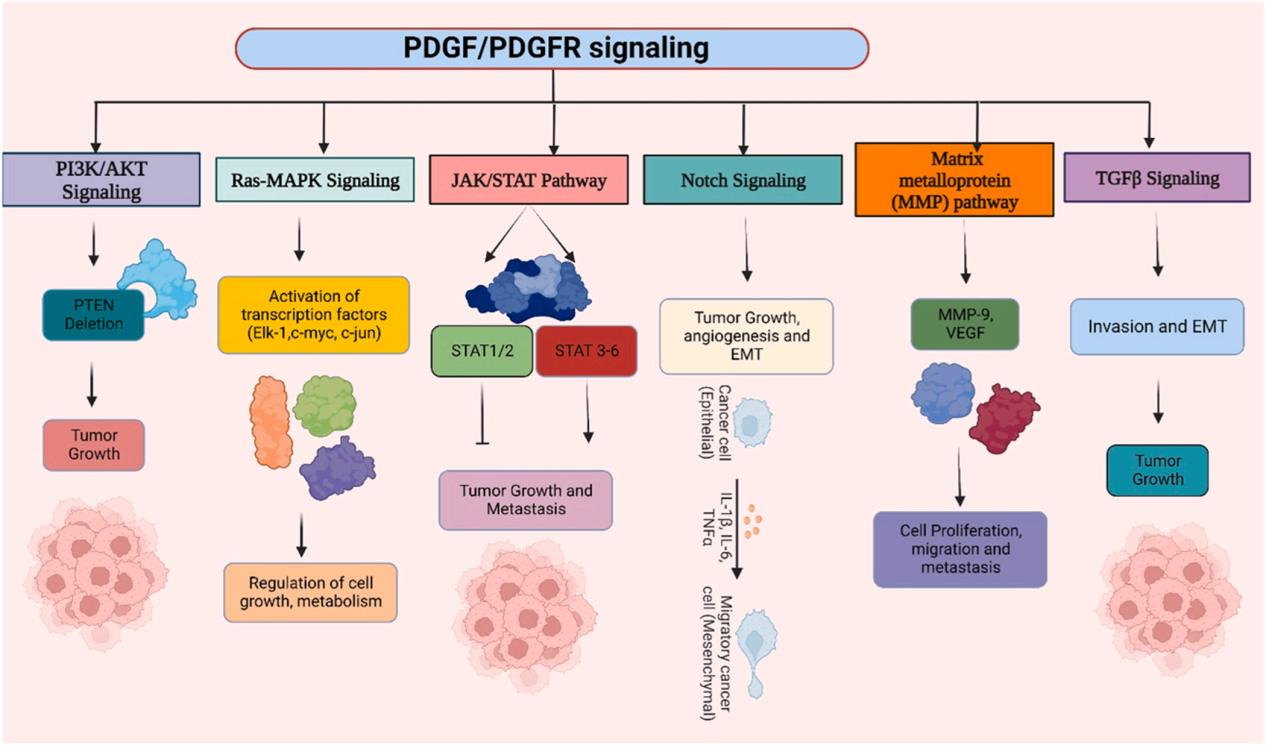

(Data source: Pandey P, et al. Biomed Pharmacother. 2023)
Targeted therapy for PDGFRA
Because inhibiting PDGFR can suppress cancer proliferation, metastasis, invasion, and angiogenesis, and enhance the antitumor effects of anticancer drugs, some new treatment strategies have emerged based on the PDGFR pathway in cancer therapy.
Olaratumab (IMC-3G3) is a monoclonal antibody targeting PDGFRA. It works by specifically interacting with PDGFRα, preventing the binding of PDGF ligands (PDGF-AA, PDGF-CC, and PDGF-BB), inhibiting PDGFR activation, and blocking downstream signaling. In many tumor models, Olaratumab downregulates cell proliferation. Based on the results of a phase Ib/II study of advanced soft tissue sarcoma, it received its first global approval in the United States in October 2016 for the treatment of soft tissue sarcoma. In this study, Olaratumab in combination with doxorubicin showed a significant increase in median overall survival of 11.8 months compared to doxorubicin alone. The European Medicines Agency (2016) granted it provisional approval for the treatment of patients with metastatic soft tissue sarcoma who are ineligible for surgery or radiotherapy. A confirmatory phase III clinical trial (NCT02451943) for the treatment of soft tissue sarcoma is currently underway abroad.

(Data source: Sun Y, et al. Front Oncol. 2022)