CD70 is primarily expressed on B cells and is the ligand for the CD27 receptor, also known as CD27L or TNFSF7. CD27 is primarily expressed on T cells, and the CD70-CD27 signaling pathway mediates the activation and expansion of antigen-specific T cells, thereby providing immune surveillance of B cells. The interaction between CD70 and CD27 can activate T cells, B cells, and NK cells, enhancing their proliferation, cytokine secretion, and survival. This co-stimulatory signal plays a key role in anti-tumor and anti-infection immunity. In hematological malignancies, cancer cells co-express CD70 and CD27, promoting the stemness, proliferation, and survival of malignant tumors. In solid tumors, only CD70 is expressed on tumor cells, which can promote immune evasion through CD27 expression in the tumor microenvironment.
Expression distribution of CD70
CD70 is primarily expressed in B cells, plasma cells, Langerhans cells, T cells, basal respiratory cells, and fibroblasts. CD70 is also expressed in various cancer cells, such as hematologic cancers, including cutaneous T-cell lymphoma, non-Hodgkin's lymphoma, multiple myeloma, mantle cell lymphoma, malignant B-cell lymphoma, and large B-cell lymphoma. It is also highly expressed in solid tumors, including renal cell carcinoma (RCC), pleural carcinoma, thymic carcinoma, osteosarcoma, glioma, head and neck squamous cell carcinoma, and melanoma.

(Data source: Kumar S, et al. Cancer Lett. 2024)
The structure of CD70 and its receptor
The CD70 gene is located on chromosome 19p13 and is a type II membrane protein composed of 193 amino acids. Its biological activity is generally observed in the form of a trimer with a molecular weight of approximately 50 kDa. Each subunit of the CD70 trimer adopts a " jelly-roll " fold built around two β sheets . Two pairs of intramolecular disulfide bonds are observed in the CD70 structure : one formed between C115 and C151 between the CD and EF loops, which is conserved among classic TNF ligands; the other formed between C133 and C168 between the Gβ fold and the DE loop, which is unique to CD70.
CD70 binds to the CD27 receptor in a classic TNF ligand homotrimeric assembly, forming a 3:3 stoichiometric complex in which each CD27 monomer interacts with two adjacent CD70 monomers.

(Data source: Liu W, et al. J Biol Chem. 2021)
Signal transduction regulation of CD70-CD27
During normal hematopoietic development, CD70 expression is tightly regulated and, through TRAF 2/5, activates the NF-κB and c-Jun pathways, playing a role in the initiation, survival, and differentiation of immune cell subsets. It can also induce apoptosis through Siva activation of the caspase pathway. Reverse CD70 signaling can activate the PI3K/Akt and MEK signaling pathways, thereby regulating cell proliferation, differentiation, and effector functions. In oncology, CD70 and CD27 are frequently co-expressed on malignant cells, where they can impart proliferative signals and growth advantages to malignant cells. In addition to improving growth, dysregulation of this axis can also provide other tumor-promoting effects through distinct signaling pathways.

In hematologic malignancies, CD70-CD27 signaling activates the canonical Wnt, JAK/STAT, Hedgehog, and TGF- β pathways, which can induce a stemness/immature state. Furthermore, crosslinking of CD27 in a protein kinase C- or β-catenin-dependent manner and reverse signaling of CD70 have been shown to induce proliferation of malignant cells. CD70-CD27 signaling can promote survival by regulating kinases of the MEK pathway and the transcription factor AP-1, as well as the Wnt pathway through β-catenin activation. In solid tumors, CD70 signaling is associated with cancer stemness and EMT transformation by inducing expression of EMT-related genes (SOX2, CD44, Vimentin, Snail, Slug , and β-catenin) , as well as MAPK activation and RhoE overexpression. Furthermore, hypoxia has been identified as a regulator of CD70 expression and a key factor in promoting tumor stemness, migration, and invasion.

(Data source: Flieswasser T, et al. J Exp Clin Cancer Res. 2022)
The role of the CD70-CD27 axis in the tumor microenvironment
The CD70-CD27 axis promotes immune evasion and suppression through distinct cell populations within the tumor microenvironment ( TME ). The CD70-CD27 axis can increase Treg survival and proliferation, as well as T cell exhaustion and apoptosis. Furthermore, this axis is associated with NK cell exhaustion and TAM migration/activation. Furthermore, CD70 expression on CAFs can promote tumor migration and invasion through Treg recruitment.

(Data source: Flieswasser T, et al. J Exp Clin Cancer Res. 2022)
CD70-targeted therapy
Several clinical trials targeting CD70 for the treatment of hematologic and solid malignancies have been initiated. In these trials, CD70 has been used as a monotherapy or in combination with chemotherapy or radiation therapy. Clinical trials of anti-CD70 have shown promising results, demonstrating anti-tumor responses and improved patient survival across a variety of malignancies.
Cusatuzumab ( ARGX-110 ) is a CD70-targeting monoclonal antibody developed for the treatment of hematologic malignancies. Its anti-tumor mode of action includes enhanced antibody-dependent cell-mediated cytotoxicity (ADCC) and inhibition of immune checkpoint signaling. Cusatuzumab , along with azacitidine, has demonstrated promising efficacy in clinical trials for newly diagnosed AML patients.
SEA-CD70 (PF-08046040) is an afucosylated monoclonal antibody targeting CD70 designed to enhance effector function . Phase 1 clinical studies have shown encouraging preliminary data. These data will be shared for the first time in a dose-optimization cohort of patients with higher-risk myelodysplastic syndromes (MDS) in combination with azacitidine. SEA-CD70 is being developed with the goal of becoming a best-in-class foundational therapy for the treatment of myeloid malignancies, either alone or in combination with other therapies.
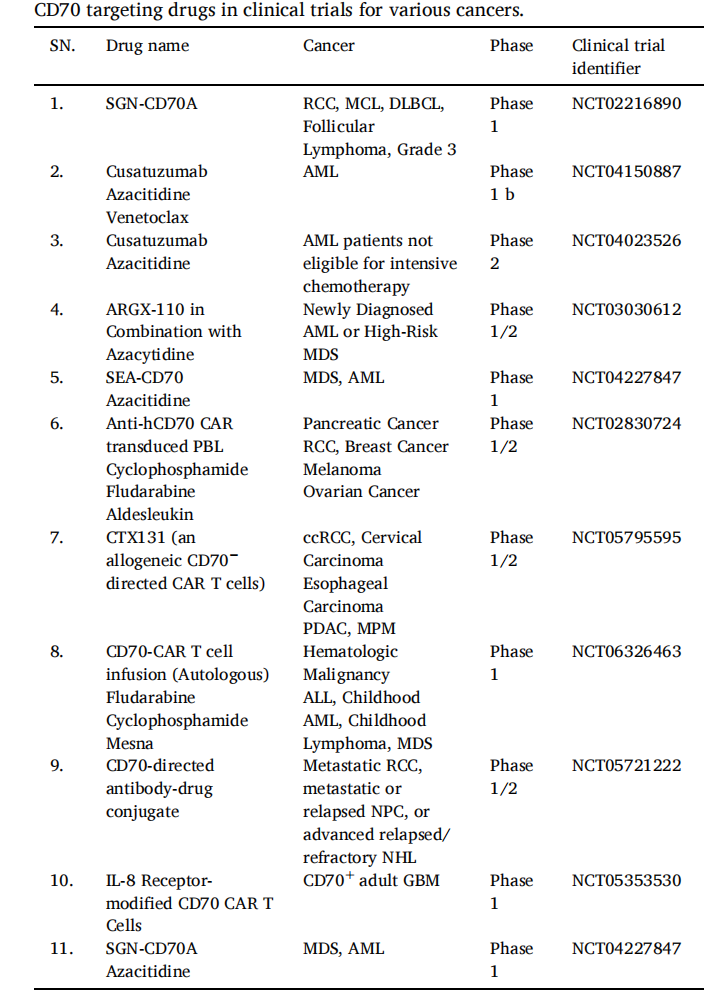
(Data source: Kumar S, et al. Cancer Lett. 2024.)